Du willst zuerst die visuelle Version? Nutze die interaktive Road to Germany Roadmap, um die Reise nach Bachelor, Master oder Promotion zu filtern, APS-Checkpoints hinzuzufügen und deinen Fortschritt im Browser zu speichern.
Was ist der schnellste Weg, das Studium in Deutschland zu planen?
Stand Juni 2026: Plane rückwärts vom gewünschten Semesterstart. Erstelle eine Hochschul-Shortlist, prüfe APS- oder VPD-Anforderungen, bewerbe dich früh, und bereite dann das Sperrkonto (11.904 € pro Jahr), Krankenversicherung, Visum, Unterkunft, Anmeldung und alle Schritte zur Arbeitsvorbereitung vor. Entscheidend ist die richtige Reihenfolge der Dokumente, bevor Reisefristen dich zu übereilten Entscheidungen zwingen.
Wer sich auf ein Studium in Deutschland vorbereitet, merkt schnell: Das Schwierigste ist nicht die Zulassung selbst. Das Schwierigste ist, alles in der richtigen Reihenfolge zu erledigen.
Du musst Hochschulen recherchieren, Sprachanforderungen prüfen, Dokumente vorbereiten, dich über das richtige Portal bewerben, auf die Zulassung warten, ein Sperrkonto eröffnen, eine Krankenversicherung abschließen, das Visum beantragen, dich immatrikulieren lassen, eine Unterkunft finden, einen Flug buchen, deine Adresse anmelden und danach den Aufenthaltstitel regeln.
Ich habe das alles selbst erlebt. Vor meiner Ankunft aus Vietnam in Deutschland habe ich eine persönliche „Road to Germany"-Checkliste in Notion und eine separate Hochschul-Recherche-Tabelle erstellt. Die Ursprungsversion war unübersichtlich, sehr persönlich und nicht immer optimal. Ich musste mein Studium an der Uni Passau sogar um ein Semester verschieben, weil der Zeitplan zu eng war.
Dieser Leitfaden macht aus diesem persönlichen System eine klarere Checkliste für andere internationale Studierende.
Kurzübersicht: Was tun und wohin springen
Nutze diese Tabelle, wenn du zuerst die Kurzversion möchtest, und spring dann in den jeweiligen Abschnitt, wenn du es genauer wissen willst.
Phase | Was tun |
|---|---|
Vergleiche deinen Hintergrund mit meinem Bewerbungsprofil, besonders wenn du dich für Informatik bewirbst. | |
Kopiere den Hochschul-Recherche-Tracker und die Road to Germany Checkliste. | |
Installiere DB Navigator, Wohnungsplattformen und Skyscanner vor der Ankunft. | |
Erstelle deinen Hochschul-Tracker, bevor du irgendwelche Dokumente vorbereitest. | |
Prüfe Sommer- und Wintersemester-Fristen und arbeite rückwärts vom Zielstart. | |
Nutze das Sommer-2027-Beispiel, wenn dein Semester um April beginnt. | |
Nutze das Winter-2027/2028-Beispiel, wenn dein Semester um Oktober beginnt. | |
Bereite IELTS/TOEFL, Deutschzertifikate falls sinnvoll, APS falls nötig, Transkripte, Lebenslauf und Bewerbungsunterlagen vor. | |
Bewerbe dich früh, besonders wenn uni-assist oder VPD erforderlich ist. | |
Wenn die Zulassung zu spät kommt, schreibe der Hochschule sofort eine E-Mail und bitte um schriftliche Bestätigung der Verschiebung. | |
Eröffne das Sperrkonto, bereite die Versicherung vor, und prüfe den aktuellen Visa-Betrag. | |
Kümmer dich um Visum, Immatrikulation, Unterkunft, Flug, Zug, Anmeldung und Aufenthaltstitel. | |
Denke an Werkstudentenjobs – aber erst, wenn Zulassung, Visum, Unterkunft und Ankunft stabil sind. | |
Überprüfe die Fehlerliste, bevor du Bewerbungen einreichst, Wohnungsgeld überweist oder Reisen buchst. | |
Nutze die Abschluss-Checkliste als einfachste Schritt-für-Schritt-Liste. |
Mein Profil bei der Bewerbung
Kontext ist wichtig, deshalb hier mein Profil zum Zeitpunkt der Bewerbung.
Ich komme aus Vietnam und habe einen B.Sc. in Informationstechnologie mit Schwerpunkt Künstliche Intelligenz an der FPT University in Ho-Chi-Minh-Stadt abgeschlossen. Mein GPA war 8,94/10, was je nach Umrechnungsmethode etwa einer 1,6 im deutschen Notensystem entspricht. Außerdem hatte ich Erfahrungen in Programmierwettbewerben, darunter ICPC Asia und ähnliche Preise.
Ich habe mich für englischsprachige M.Sc.-Informatik-Studiengänge an der Universität Bonn und der Universität Passau beworben. Uni Bonn hat mich abgelehnt, Uni Passau hat mich zugelassen.
Die Ablehnung durch Uni Bonn war eine wichtige Lektion: Mein FPT-Studiengang hatte nicht genug Theoretische Informatik-Credits, und ich konnte meine Fächer im Bachelor nicht frei wählen. Wenn ein deutsches Programm theoretische Informatik-Credits verlangt, schau dir dein Transcript sehr genau an. Es werden möglicherweise Kurse wie Theoretische Informatik, Automatentheorie, Berechenbarkeit, formale Sprachen, Komplexitätstheorie oder ähnliche Fächer erwartet. Geh nicht davon aus, dass „Informatik" oder „Informationstechnologie" allein ausreicht.
Für Sprachzertifikate hatte ich IELTS 7,5 und das Goethe-Zertifikat A1. Ich absolvierte zu diesem Zeitpunkt auch gerade einen A2-Deutschkurs. Uni Passau hat mir erlaubt, das A1-Deutschzertifikat innerhalb des ersten Studienjahres nachzureichen, aber ich hatte es bereits vor der Ankunft in Deutschland.
Da ich aus Vietnam kam, brauchte ich außerdem ein APS-Zertifikat. Meine APS-Fragen waren gut handhabbar, und das Interview bestand aus zwei freundlichen Professorinnen und Professoren, die entspannt zu reden waren. Trotzdem: Unterschätze das APS-Timing nicht. Bereite deine Dokumente früh vor und geh dein eigenes Transcript, deine Abschlussarbeit und deine Hauptfächer vor dem Interview nochmal durch.
Kostenlose Vorlagen: Hochschulen recherchieren und die Road to Germany planen
Nutze diese beiden Vorlagen zusammen. Die erste hilft dir zu entscheiden, wo du dich bewirbst. Die zweite hilft dir, alles danach vorzubereiten.
Vorlage | Am besten für |
|---|---|
Hochschulen vergleichen: Englischvoraussetzungen, Deutschvoraussetzungen, Sommerfristen, Winterfristen, Semesterbeitrag oder Studiengebühr, Notizen und Priorität | |
IELTS, Deutsch, APS, Dokumente, Bewerbungen, Sperrkonto, Visum, Immatrikulation, Flüge und Anmeldung verfolgen |
Starte mit dem Hochschul-Recherche-Tracker. Eine Visum-Checkliste ist sinnvoll, aber erst, wenn du weißt, welche Hochschulen und Programme du anvisierst.
Must-have-Apps und Plattformen vor der Ankunft
Das sind die Apps und Plattformen, die ich vor dem Abflug vorbereiten würde:
App oder Plattform | Wofür |
|---|---|
Zug- und Busverbindungen, Gleiswechsel, Verspätungen und mobile Tickets. | |
WG-Zimmer, Privatzimmer und kurzfristige Wohnungsangebote. | |
Private Wohnungen und Zimmer. | |
Eine weitere Wohnungsplattform für Wohnungen und Zimmer. | |
Flugpreise, Airlines, Routen, Zwischenstopps und Gesamtreisedauer vergleichen. |
Schritt 1: Hochschulen recherchieren, bevor du alles andere vorbereitest
Der erste Fehler vieler Studierender ist, mit den Dokumenten anzufangen, bevor sie die Zielhochschulen wirklich kennen.
Das fühlt sich produktiv an, kann aber Zeit verschwenden. Deutsche Hochschulen stellen nicht alle die gleichen Anforderungen. Ein Studiengang akzeptiert vielleicht IELTS 6,0, ein anderer verlangt 6,5 oder 7,0. Eine Hochschule nutzt uni-assist, eine andere hat ein eigenes Portal. Eine verlangt APS oder eine VPD, eine andere hat eine viel frühere Frist als erwartet.
Deine erste Tabelle sollte die Grundlagen abdecken:
Feld | Was eintragen |
|---|---|
Hochschule | Offizieller Name der Hochschule |
Offizieller Link | Die Programm- oder Zulassungsseite, kein zufälliger Blog |
Sprachanforderungen | IELTS/TOEFL/Cambridge, Deutschniveau und ob der Studiengang rein englischsprachig ist |
Sommerfrist | Die offizielle Frist für einen April/März-Start, sofern angeboten |
Winterfrist | Die offizielle Frist für einen Oktober/September-Start |
Semesterbeitrag oder Studiengebühr | Semesterbeitrag, Studiengebühr oder „keine Studiengebühr" wenn bestätigt |
Notizen | Credit-Anforderungen, APS, VPD, Zulassungsbeschränkung (NC), besondere Dokumente |
Priorität/Status | Hohe Priorität, mittlere Priorität, Backup, beworben, zugelassen, abgelehnt |
Genau deshalb habe ich ein separates Hochschul-Recherche-Dokument erstellt. Das Ziel ist nicht, eine schöne Datenbank zu bauen. Das Ziel ist, eine wichtige Regel, die irgendwo auf einer Hochschulseite versteckt ist, nicht zu verpassen.
Für die offizielle Programmsuche empfehle ich die DAAD-Datenbank für internationale Studiengänge, dann jeden Detail auf der Hochschulwebsite selbst prüfen.
Schritt 2: Die Bewerbungssaison verstehen
Deutsche Hochschulen arbeiten in der Regel mit zwei Anfangsterminen:
Sommersemester: beginnt üblicherweise um März oder April.
Wintersemester: beginnt üblicherweise um September oder Oktober.
Laut dem DAAD-Leitfaden zum Bewerbungsverfahren beginnen viele Wintersemester-Bewerbungsphasen Anfang Mai und enden am 15. Juli. Für das Sommersemester laufen viele Bewerbungsphasen von Anfang Dezember bis zum 15. Januar.
Der DAAD gibt außerdem an, dass Zulassungsbescheide für das Sommersemester oft im Februar oder März und für das Wintersemester im August oder September verschickt werden.
Das ist der stressige Teil.
Wenn du Mitte März ein Ergebnis für einen April-Start erhältst, oder Mitte September für einen Oktober-Start, hast du möglicherweise nicht genug Zeit, Visum, Unterkunft, Immatrikulation und Flug in Ruhe zu organisieren. Flugtickets werden außerdem teuer, wenn man zu spät bucht.
Deshalb empfehle ich, mit konkreten Daten zu planen statt mit vagen Formulierungen wie „ein paar Monate vorher".
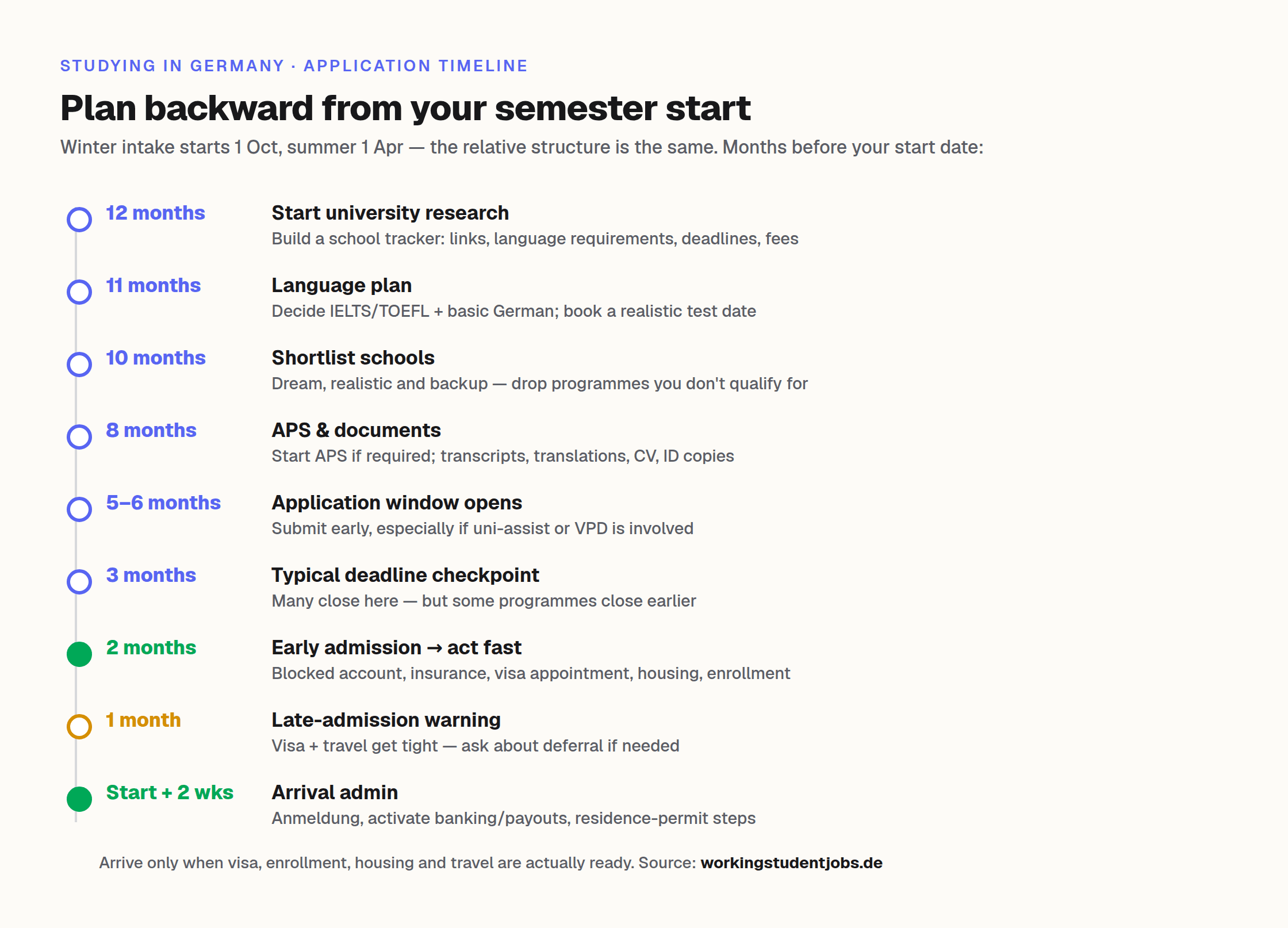
Beispiel-Timeline für das Sommersemester 2027
Annahme: Dein Studium beginnt am 01.04.2027.
Das ist eine praktische Timeline, die du in die Road to Germany Checkliste übernehmen kannst. Die genauen Fristen deiner Hochschule können früher oder später liegen, also prüfe immer die offizielle Hochschulseite.
Datum | Punkt | Was tun |
|---|---|---|
01.04.2026 | Hochschulrecherche starten | Hochschul-Tracker aufbauen. Offizielle Links, Sprachanforderungen, Fristen, Gebühren und Notizen eintragen. |
01.05.2026 | Sprachplan | Entscheide, ob du IELTS/TOEFL brauchst, und ob Deutsch A1–B1 deiner Ankunft hilft. Realistischen Testtermin buchen. |
01.06.2026 | Hochschulen eingrenzen | Hochprioritäre, mittelprioritäre und Backup-Hochschulen auswählen. Programme streichen, bei denen du die Anforderungen eindeutig nicht erfüllst. |
01.08.2026 | APS und Dokumentenvorbereitung | Falls dein Land APS erfordert, früh starten. Transkripte, Zeugnisse, Übersetzungen, Lebenslauf und Ausweiskopien vorbereiten. |
01.10.2026 | Bewerbungsunterlagen | Motivationsschreiben verfassen, Empfehlungsschreiben anfragen, Notenumrechnung vorbereiten und Dokumente sauber einscannen. |
01.12.2026 | Bewerbungsfenster öffnet | Viele Sommersemester-Bewerbungen öffnen Anfang Dezember. Früh einreichen, besonders wenn uni-assist oder VPD erforderlich ist. |
15.01.2027 | Typischer Frist-Checkpoint | Viele Sommerbewerbungen schließen um den 15. Januar. Verwende das nicht als einzige Regel – manche Programme schließen früher. |
15.02.2027 | Frühes Zulassungsfenster | Bei früher Zulassung sofort Sperrkonto, Versicherung, Visumtermin, Wohnungssuche und Immatrikulation angehen. |
15.03.2027 | Warnung bei später Zulassung | Wenn die Zulassung etwa Mitte März eintrifft, fragen, ob der Zeitplan noch realistisch ist. Falls nicht, sofort die Hochschule bezüglich Verschiebung kontaktieren. |
01.04.2027 | Semesterbeginn | Erst ankommen, wenn Visum, Immatrikulation, Unterkunft und Reiseplan wirklich bereit sind. |
15.04.2027 | Ankunft und Behörden | Adresse anmelden, Banking/Auszahlungen aktivieren und Aufenthaltstitel-Schritte vorbereiten, falls erforderlich. |
Wichtige Erkenntnis: Für Sommer 2027 ist ein Ergebnis am 15.03.2027 sehr spät. Für EU-Studierende oder Personen mit bereits vorhandenem Visaweg ist das machbar, für viele Nicht-EU-Studierende ist es hingegen nicht komfortabel.
Beispiel-Timeline für das Wintersemester 2027/2028
Annahme: Dein Studium beginnt am 01.10.2027.
Das ist der Eintrittstermin, an den die meisten internationalen Studierenden zuerst denken, da viele Programme im Winter beginnen.
Datum | Punkt | Was tun |
|---|---|---|
01.10.2026 | Hochschulrecherche starten | Hochschul-Tracker aufbauen. Offizielle Programm-Links, Sprachanforderungen, Fristen, Gebühren und Notizen eintragen. |
01.11.2026 | Sprachplan | IELTS/TOEFL-Termin wählen und entscheiden, ob du vor der Ankunft Grundkenntnisse Deutsch lernen möchtest. |
01.12.2026 | Hochschulen eingrenzen | Traum-, realistische und Backup-Hochschulen trennen. Prüfen, ob jede deinen Abschluss und deine Credits akzeptiert. |
01.02.2027 | APS und Dokumentenvorbereitung | APS oder länderspezifische Akademikprüfungen starten, falls erforderlich. Übersetzungen, Lebenslauf, Zeugnisse, Transkripte und Ausweiskopien vorbereiten. |
01.04.2027 | Vollständiges Bewerbungspaket | Motivationsschreiben, Empfehlungsschreiben, Notenumrechnung und eingescannte Dokumente fertigstellen. |
01.05.2027 | Bewerbungsfenster öffnet | Viele Wintersemester-Bewerbungen öffnen Anfang Mai. Früh einreichen, wenn uni-assist oder VPD erforderlich ist. |
15.07.2027 | Typischer Frist-Checkpoint | Viele Winterbewerbungen schließen um den 15. Juli. Manche Programme schließen früher, vertraue der Hochschulseite. |
15.08.2027 | Frühes Zulassungsfenster | Bei früher Zulassung sofort Sperrkonto, Krankenversicherung, Visumantrag, Immatrikulation, Unterkunft und Flugplanung starten. |
15.09.2027 | Warnung bei später Zulassung | Wenn die Zulassung etwa Mitte September eintrifft, können Visum- und Reise-Timeline knapp werden. Bei Bedarf nach Verschiebung fragen. |
01.10.2027 | Semesterbeginn | Nur starten, wenn Visum, Immatrikulation und Anreise-Logistik wirklich unter Kontrolle sind. |
15.10.2027 | Ankunft und Behörden | Adresse anmelden, Banking/Auszahlungen aktivieren und Aufenthaltstitel-Schritte fortsetzen, falls erforderlich. |
Du kannst diese Daten kopieren und das Jahr anpassen. Die relative Struktur bleibt dieselbe:
Sommersemester: Startdatum auf den 01.04 ausrichten.
Wintersemester: Startdatum auf den 01.10 ausrichten.
Von diesem Datum rückwärts arbeiten.
Schritt 3: Sprachtests und akademische Dokumente vorbereiten
Für englischsprachige Studiengänge ist IELTS, TOEFL oder ein anderes anerkanntes Englischzertifikat die häufigste Sprachanforderung. Manche Programme akzeptieren ein früheres Englisch-Studium, aber geh nicht davon aus. Prüfe die offizielle Programmseite.
Auch bei rein englischsprachigen Programmen helfen Grundkenntnisse in Deutsch in den ersten Monaten in Deutschland. Du brauchst kein perfektes Deutsch, um zurechtzukommen, aber A1/A2 hilft bei Wohnungsanfragen, der Anmeldung, Telefonanrufen, Briefen und Nebenjobs. Wenn du später Jobs suchst, erweitert Deutsch auch deine Optionen. Du kannst englischsprachige Werkstudenten-Optionen auf workingstudentjobs.de vergleichen, aber deutschsprachige Stellen sind weiterhin häufiger.
Für Dokumente, früh vorbereiten:
Reisepass oder Personalausweis-Kopie, je nach Anforderung des Portals.
Schulzeugnis, falls erforderlich.
Bachelor-Zeugnis oder aktueller Immatrikulationsnachweis.
Transcript of Records.
Beglaubigte Übersetzungen, falls erforderlich.
Lebenslauf auf Englisch oder Deutsch.
Motivationsschreiben.
Empfehlungsschreiben.
Erklärung oder Umrechnung des Notensystems.
Zusammenfassung der Abschlussarbeit oder des Abschlussprojekts, falls das Programm das verlangt.
Wer aus Vietnam, Indien, China oder einem anderen APS-Land kommt, sollte die APS-Anforderungen früh prüfen. Für Vietnam erklären die Seiten der Deutschen Botschaft den APS-Prozess im Überblick und das Verfahren für ein Weiterstudium in Deutschland. Warte nicht bis zur Bewerbungsfrist der Hochschule, um dich über APS zu informieren.
Schritt 4: Frühzeitig bewerben, besonders wenn uni-assist involviert ist
Manche Hochschulen nehmen Bewerbungen direkt über ihr eigenes Portal an. Andere nutzen uni-assist. Wieder andere nutzen uni-assist nur für eine Vorprüfung, die sogenannte VPD, die du dann selbst bei der Hochschule einreichst.
Der genaue Weg ist wichtig. Wenn eine Hochschule nach Ausstellung der VPD durch uni-assist eine direkte Einreichung erwartet, kann das Versäumen des zweiten Schritts deine Bewerbung zunichtemachen.
uni-assist empfiehlt, sich so früh wie möglich zu bewerben, mindestens 8 Wochen vor der Frist, und die Bearbeitung dauert in der Regel 4 bis 6 Wochen ab dem Eingang der Online-Bewerbung und Zahlung. Mehr dazu auf der offiziellen Seite zu uni-assist-Fristen und Bearbeitungszeiten.
Daher setzen die obigen Beispiel-Timelines die Bewerbungsvorbereitung vor die offizielle Frist. Am letzten Tag zu bewerben ist keine Strategie. Es ist ein Risiko.
Schritt 5: Wenn die Zulassung zu spät kommt, nach Verschiebung fragen
Das ist der Teil, den viele Leitfäden nicht klar erklären.
Zulassungsergebnisse können spät kommen. Der DAAD sagt, Zulassungsbescheide werden oft im Februar/März für das Sommersemester und im August/September für das Wintersemester verschickt. In der Praxis erhalten manche Studierende ihre Ergebnisse kurz vor Semesterbeginn.
Als Nicht-EU-Studierende:r kann das ein Problem sein. Möglicherweise fehlen noch:
Sperrkonto-Bestätigung.
Krankenversicherungsnachweis.
Visumtermin und -bearbeitung.
Immatrikulationsunterlagen.
Unterkunft.
Flugticket.
Anmeldungs-Termin nach der Ankunft.
In meinem Fall hat Uni Passau mir erlaubt, die Zulassung um ein Semester zu verschieben, nachdem ich explizit per E-Mail darum gebeten hatte. Das gab mir Zeit, Visum, Flug und Anreise ruhiger zu organisieren.
Aber geh nicht davon aus, dass deine Hochschule dasselbe tut.
Wenn dein Ergebnis zu spät kommt, wende dich sofort an das Zulassungsbüro. Stelle eine konkrete Frage:
Ich bin für das kommende Semester zugelassen worden, aber mein Visum- und Reise-Zeitplan ist möglicherweise nicht realistisch. Ist es möglich, meine Zulassung um ein Semester zu verschieben? Falls ja, können Sie mir den Prozess bitte schriftlich bestätigen?
Warte auf eine schriftliche Bestätigung. Wenn du einfach nicht zum Semesterbeginn erscheinst, kann die Hochschule dich als eingeschrieben aber abwesend behandeln, oder du verlierst den Studienplatz je nach Regelung. Das kann außerdem einen Teil deiner maximal erlaubten Studiendauer aufbrauchen. Bei vielen Master-Programmen denken Studierende in der Regel in Kategorien von 6 bis 8 Fachsemestern Regelstudienzeit. Bei Bachelor-Programmen können es rund 8 bis 10 Semester sein. Die genaue Regelung hängt von der Hochschule und dem Programm ab, also prüfe das direkt mit deinem Prüfungsamt oder Zulassungsbüro.
Eine Verschiebung ist kein Schlupfloch. Es ist ein offizieller Antrag. Nimm ihn ernst.
Schritt 6: Sperrkonto eröffnen und Versicherung vorbereiten
Für viele Nicht-EU-Studierende ist das Sperrkonto der größte finanzielle Schritt nach der Zulassung.
Ein Sperrkonto zeigt, dass du über ausreichende Mittel für deinen Aufenthalt in Deutschland verfügst. Das Auswärtige Amt erklärt Sperrkonten und weist darauf hin, dass es keine bestimmten Anbieter empfiehlt. Eine Checkliste des Auswärtigen Amts für das Studentenvisum verwendet derzeit 992 EUR pro Monat und 11.904 EUR für das erste Jahr als Betrag für Studierende. Bestätige den aktuellen Betrag immer bei der deutschen Auslandsvertretung, die für dein Visum zuständig ist, bevor du Geld überweist.
Ich habe persönlich Expatrio genutzt und war mit dem Service für meinen eigenen Prozess sehr zufrieden. Wenn du denselben Anbieter nutzen möchtest, kannst du dich hier bei Expatrio registrieren*.
Zum Zeitpunkt der Erstellung dieses Beitrags sollte dieser Empfehlungslink dir einen Bonus von 15 EUR geben. Bestätige den von Expatrio angezeigten Bonus vor der Registrierung, da sich Empfehlungsbedingungen ändern können.
Expatrios Value Package Seite beschreibt, dass das Paket mehrere Ankunftsservices bündelt: ein Sperrkonto, Reisekrankenversicherung für deine erste Zeit in Deutschland, Krankenversicherungsoptionen wie die TK-Krankenversicherung und ein kostenloses Bankkonto. Das ist praktisch, weil du einen Nachweis für das Visum, eine Reiseversicherung für die Ankunft, eine studentische Krankenversicherung für die Immatrikulation und ein Konto für monatliche Sperrkonto-Auszahlungen nach der Ankunft brauchst.
Meine ehrliche Einschätzung:
Expatrio ist eine praktische Option für Sperrkonto und Visumvorbereitung.
Das kostenlose Bankkonto kann für die Ankunft und monatliche Auszahlungen ausreichen.
Die App ist einfach gehalten, was für den Sperrkonto-Anwendungsfall in Ordnung ist.
Wenn du eine alltagstauglichere Banking-App für Gehalt, Miete, Karten und tägliche Ausgaben möchtest, kannst du auch bunq in Betracht ziehen.
Für die Banking-Seite lies unseren Artikel über das beste Bankkonto für Werkstudenten in Deutschland. Wenn du speziell eine deutsche IBAN und eine englische Mobile-Banking-App möchtest, kannst du auch bunq hier eröffnen*. Für einen ausführlicheren Gehaltskonten-Vergleich lies bunq vs. Wise für Werkstudenten-Gehalt in Deutschland.
Schritt 7: Visum, Immatrikulation, Unterkunft, Zug und Ankunft
Nach der Zulassung wird deine Checkliste administrativer.
Nutze die Road to Germany Checkliste, um Folgendes zu verfolgen:
Punkt | Frist | Notizen |
|---|---|---|
Sperrkonto | Nach Zulassung, vor Visum | Den aktuellen Betrag bei deiner deutschen Auslandsvertretung erfragen. |
Visum | Sobald Dokumente bereit sind | Sperrkonto, Versicherung, Zulassungsschreiben, Pass, Fotos, Formulare und lokale Botschaftsanforderungen. |
Immatrikulation | Vor der Einschreibefrist der Hochschule | Erforderliche Dokumente hochladen oder einsenden, Semesterbeitrag zahlen und Immatrikulationsbestätigung erhalten. |
Unterkunft | Früh beginnen, aber realistisch einschätzen | Studentenwohnheime, WG-Zimmer, Privatzimmer, kurzfristige Übergangslösung. |
Flugtickets | Wenn Visumszusage sicher ist | Tools wie Skyscanner nutzen, um Preis, Airline, Route, Zwischenstopps und Gesamtdauer zu vergleichen. |
Zugticket | Vor der Abreise | Planen, wie du vom Flughafen in deine Universitätsstadt reist. |
Flug nach München/Berlin/Frankfurt | Im Ankunftszeitraum | Flughafen je nach Universitätsstadt und Zugverbindung wählen. |
Adresse anmelden | So früh wie möglich buchen | Lokale Stadtregeln und Terminverfügbarkeit vor der Ankunft prüfen, wenn deine Stadt das erlaubt. |
DAAD hat eine nützliche Ankunftsübersicht im Destination Germany Guide, u. a. zu Geld, Versicherung, Visum/Aufenthaltstitel und Anmeldung.
Deine ersten Wochen in Deutschland werden entspannter, wenn du bereits weißt:
Wo du im ersten Monat schläfst.
Welchen Flughafen und welche Zugroute du nutzen wirst.
Wie du vom Flughafen in deine Stadt kommst.
Ob die Sperrkonto-Auszahlung aktiviert werden muss.
Ob dein Bankkonto bereit ist.
Wie du in deiner Stadt einen Anmeldungs-Termin buchst.
Welche Dokumente die Hochschule für die endgültige Immatrikulation noch benötigt.
Anmeldung und Aufenthaltstitel-Termine
Wenn deine Stadt Online-Terminbuchung anbietet, schau dir Anmeldungs-Termine vor der Ankunft an und buche so früh wie möglich. Termine sind nicht immer 1 bis 2 Wochen im Voraus verfügbar. In manchen Städten oder in Stoßzeiten kann die Wartezeit mehrere Wochen betragen. Eine Schritt-für-Schritt-Anleitung dazu, was du mitbringen musst und wie der Prozess abläuft, findest du in unserem Anmeldungs-Guide für Deutschland.
Nach der Anmeldung benötigst du je nach Visumsdauer möglicherweise auch einen Termin für den Aufenthaltstitel. Wenn dein Einreisevisum 6 Monate oder 1 Jahr gültig ist, warte nicht bis zum letzten Moment. Eine praktische Faustregel: Fange 3 oder mehr Monate vor Ablauf deines Visums an, Termine zu prüfen und zu buchen.
Buche den Termin für den Aufenthaltstitel aber auch nicht zu früh ohne konkreten Grund. In Passau wurde mir beim Bürgeramt gesagt, dass ein Antrag zu kurz nach der Ankunft abgelehnt werden kann, weil das Visum noch zu lange gültig ist. In deiner Stadt kann das anders gehandhabt werden, also prüfe die Hinweise des lokalen Ausländeramts oder Bürgeramts.
Unterkunft: Früh beginnen, aber den realen Zeitplan verstehen
Unterkunft ist einer der stressigsten Teile der Ankunft, besonders wenn du von außerhalb Deutschlands ein Privatzimmer oder eine WG suchst.
Für private Unterkunft kannst du früh damit beginnen, den Markt zu beobachten, aber viele Vermieter bevorzugen jemanden, der bereits in Deutschland ist und die Wohnung besichtigen kann. In der Praxis ist es oft realistischer, 1 bis 2 Wochen vor der Ankunft ein Zimmer zu suchen, als versuchen, Monate im Voraus etwas zu sichern. Wenn du Vermieter mehr als zwei Wochen vor deinem Anreisedatum kontaktierst, werden viele das Zimmer einfach an jemanden vermieten, der früher einziehen kann.
Wenn du bis zum Abflug noch kein Zimmer gefunden hast, buche ein Airbnb, Hotel, Hostel oder eine andere kurzfristige Unterkunft für die ersten 1 bis 2 Wochen. Nutze diese Zeit dann aktiv: Schreibe täglich Vermieter an, gehe zu Besichtigungen, bereite deine Unterlagen vor und antworte schnell.
Bei Studentenwohnheimen ist das Timing anders. Wende dich so früh wie möglich an deine Hochschule oder das Studierendenwerk, idealerweise 3 bis 6 Monate vor der Ankunft. Wohnheimzimmer sind beliebt, und freie Plätze können schnell vergeben sein. Geh nicht davon aus, dass du nach der Ankunft noch eines bekommst.
Für Privatzimmer und WGs prüfe Plattformen wie WG-Gesucht, ImmoScout24 und ImmoWelt. Auch wenn dein Deutsch nicht fließend ist, versuche die erste Nachricht auf Deutsch zu schreiben. Das kann deine Chancen auf eine Antwort erhöhen.
In meinem Fall hatte ich großes Glück. Ich habe über WG-Gesucht etwa eine Woche vor der Ankunft einen Vermieter kontaktiert. Wir haben den Vertrag online unterzeichnet, und er hat mich nicht gebeten, sofort eine Kaution oder Vorauszahlung zu leisten. Ich habe bezahlt, nachdem ich in Deutschland angekommen war.
Aber behandle das als Glück, nicht als Normalfall. Wenn du noch nicht in Deutschland bist und niemanden bittest, die Wohnung für dich zu besichtigen, sei sehr vorsichtig. Überweise keine Kaution, Vorauszahlung oder erste Monatsmiete im Voraus für eine Wohnung, die du nicht überprüft hast. Wohnungsbetrügereien existieren, und internationale Studierende sind leichte Ziele, weil sie unter Stress und Zeitdruck stehen.
Du brauchst dafür kein perfektes Deutsch. Die meiste Kommunikation mit einem Vermieter passiert vor der Besichtigung oder dem Vertrag vielleicht nur einmal oder zweimal. Das Schwerere ist in der Regel das Papierkram: Mietvertrag, Kaution, Ausweis, Immatrikulationsnachweis, Einkommensnachweis, Bürgschaftsdokumente oder andere Unterlagen. Verträge sind in der Regel auf Deutsch, also nutze Tools wie ChatGPT oder Claude, um den Text zu übersetzen und zu prüfen, bevor du unterschreibst. Wenn etwas unklar oder riskant erscheint, frage den Vermieter oder jemanden, dem du vertraust, bevor du zustimmst.
Flugticket: Preis, Dauer und Route vergleichen
Bei Flügen würde ich nicht nur das günstigste Ticket suchen. Nutze Skyscanner oder ein ähnliches Flugvergleichstool, um Folgendes zu vergleichen:
Gesamtpreis.
Gesamtreisedauer.
Anzahl der Zwischenstopps.
Zielflughafen.
Ankunftszeit.
Gepäckregeln.
Das günstigste Ticket ist nicht immer die beste Option, wenn es sehr spät ankommt, einen riskanten Zwischenstopp hat oder an einem Flughafen mit schlechter Zugverbindung zu deiner Stadt landet. Wenn deine Visumssituation noch unsicher ist, buche nicht zu früh. Wenn dein Visum wahrscheinlich oder bereits erteilt ist, kann frühes Buchen helfen, teure Last-Minute-Preise zu vermeiden.
Zugticket: Die Route vom Flughafen in die Stadt vor dem Abflug planen
Du solltest dein Zugticket auch kaufen – oder zumindest planen – während du noch in deiner Heimat bist. Nach einem langen Flug möchtest du nicht zum ersten Mal am Flughafen deutsche Tarifzonen, Verspätungen, Bahnsteige und Ticketarten herausfinden.
In meinem Fall bin ich am Münchner Flughafen gelandet und musste nach Passau reisen. Ich habe ein Bayern-Ticket gekauft, weil ich damit einen Tag lang mit Regionalzügen in Bayern fahren konnte. Diese Flexibilität war wichtig. Wenn ein Zug wegen Wetter, Schnee oder einer vorherigen Verbindung Verspätung hatte, konnte ich trotzdem einen anderen Regionalzug nehmen und die Reise fortsetzen.
Ein separates Einzelticket für jede Strecke zu kaufen ist unpraktisch, wenn man neu ist, müde und mit Gepäck unterwegs ist. Ein Tages- oder Regionalticket kann die bessere Wahl sein, wenn es für deine Route passt, weil es dir mehr Flexibilität gibt, wenn etwas schiefgeht.
Lade die DB Navigator App vor der Ankunft herunter. Du wirst sie oft für Routenplanung, Gleisänderungen, Verspätungen und Tickets nutzen.
Wenn du aus einem anderen Teil Europas ankommst oder Busse mit Zügen vergleichen möchtest, kannst du Züge, Busse und Flüge in einer Suche vergleichen*. Das ist nützlich, wenn der Direktzug teuer ist oder die Strecke vom Flughafen in die Stadt umständlich ist, da ein Fernbus manchmal günstiger ist und die Buchung an einem Ort erfolgt.
Für eine schnelle Routensuche im DB Navigator:
Wähle deinen Flughafen als Startpunkt.
Wähle deine Universitätsstadt oder den Zielbahnhof als Ziel.
Wenn du Regionalzüge nutzen möchtest, aktiviere den Filter für Deutschland-Ticket-only-Verbindungen oder Regional- und Nahverkehrsverbindungen.
Das hilft, ICE und andere Fernzüge herauszufiltern. ICE-Züge sind schneller, aber in der Regel teurer. Wenn dein Budget es erlaubt, kann der ICE eine gute Option sein, besonders nach einem langen Flug. Denke aber daran: Preise werden meist deutlich teurer, je näher das Reisedatum rückt, also buche früh, wenn du den ICE wählst.
Schritt 8: Über Arbeit nachdenken – aber nicht zu früh
Viele internationale Studierende wollen schnell einen Werkstudentenjob finden. Das ist verständlich. Deutschland ist teuer, und Werkstudentenstellen sind auch einer der besten Wege, hier eine Karriere aufzubauen.
Aber bringe die Reihenfolge nicht durcheinander.
Vor der Ankunft liegt deine Priorität auf Zulassung, Visum, Unterkunft, Finanzen und Immatrikulation. Sobald dein Ankunftsplan stabil ist, beginne Lebenslauf, LinkedIn, GitHub oder Portfolio und Job-Alert-Filter vorzubereiten.
Mein eigener Fall war ungewöhnlich schnell. Ich kam am 26.09.2025 in Deutschland an. Um den 10.10.2025 erhielt ich ein Angebot von einem kleinen FinTech-Startup mit flexiblem Bürosetup rund um Heilbronn und München, und ich fing am 20.10.2025 an zu arbeiten.
Die meiste Zeit arbeitete ich remote aus Passau, wo ich lebe und studiere. Etwa eine Woche im Monat reiste ich ins Büro, um vor Ort mit allen zu arbeiten. Das Unternehmen hat das Hotel in diesen Bürowochen bezahlt, und ehrlich gesagt war es ein sehr schöner Einstieg ins Arbeitsleben in Deutschland.
Aber behandle das nicht als normalen Zeitplan. Ich hatte Glück mit Timing, Passgenauigkeit und Remote-Flexibilität. Viele Studierende brauchen mehrere Wochen oder Monate, um ihren ersten Werkstudentenjob zu finden, besonders wenn sie noch ihr Deutsch verbessern, sich an die Hochschule gewöhnen oder auf Behördenerledigungen warten.
Wenn du bereit bist, lies:
Du kannst auch englischsprachige Werkstudenten- und Praktikumsstellen in Deutschland durchsuchen.
Häufige Fehler vermeiden
Fehler 1: Hochschulen nur aus zufälligen Listen auswählen. Nutze zufällige Listen zur Entdeckung, aber vertraue den offiziellen Hochschulseiten für Anforderungen und Fristen.
Fehler 2: Sommer- und Winterfristen nicht beide verfolgen. Eine Hochschule kann beide Eintrittstermine, nur einen oder unterschiedliche Fristen für internationale Studierende haben.
Fehler 3: Mit dem Zulassungsschreiben auf die Finanzierungsplanung warten. Du brauchst das Sperrkonto möglicherweise nicht vor der Bewerbung, aber du solltest wissen, wie du es finanzieren wirst.
Fehler 4: Zu spät über uni-assist bewerben. Die Bearbeitung durch uni-assist kann Wochen dauern. Früh bewerben.
Fehler 5: Davon ausgehen, dass eine Verschiebung automatisch möglich ist. Ist sie nicht. Schreibe der Hochschule und hole eine schriftliche Bestätigung ein.
Fehler 6: Flüge buchen, bevor die Visumszusage sicher ist. Günstige Tickets sind verlockend, aber ein abgelehntes oder verzögertes Visum macht sie wertlos.
Fehler 7: Deutsch völlig ignorieren. Englisch kann für das Studium reichen, aber Grundkenntnisse in Deutsch helfen bei Unterkunft, Behörden und Jobs.
Fehler 8: Wohnungsgeld überweisen, ohne die Wohnung überprüft zu haben. Wenn du noch nicht in Deutschland bist und keine vertrauenswürdige Person die Wohnung für dich besichtigen kann, sei sehr vorsichtig mit Kautionen oder Vorauszahlungen.
Fehler 9: Anmeldungs- oder Aufenthaltstitel-Termine zu spät buchen. Termine können schnell verschwinden, prüfe die Verfügbarkeit frühzeitig und verstehe den Prozess in deiner Stadt.
Abschließende Checkliste
Wenn du die einfachste Version möchtest, tu Folgendes:
Erstelle zuerst deinen Hochschul-Recherche-Tracker.
Wähle deinen Zieleintrittsterm: Sommersemester 2027 oder Wintersemester 2027/2028.
Kopiere die passende Timeline-Tabelle aus diesem Beitrag.
Ersetze die Beispieldaten bei Bedarf durch dein genaues Semesterstartdatum.
Bewirb dich früh, besonders wenn uni-assist oder APS involviert ist.
Wenn die Zulassung zu spät eintrifft, sofort nach Verschiebung fragen.
Nach der Zulassung zügig handeln: Sperrkonto, Versicherung, Visum, Immatrikulation, Unterkunft, Flug und Zugplanung.
Vor der Ankunft wichtige Apps installieren und Anmeldungs-Terminverfügbarkeit prüfen, wenn deine Stadt Online-Buchung anbietet.
Nach der Ankunft Adresanmeldung, Banking, Aufenthaltstitel und Jobvorbereitung angehen.
Du brauchst kein perfektes System. Du brauchst ein sichtbares System, das verhindert, dass du wichtige Fristen verpasst.
Starte mit dem Germany University Research Tracker. Dann nutze die Road to Germany Checkliste, sobald deine Zielhochschulen und dein Eintrittstermin feststehen.
* Einige Links auf dieser Seite sind Werbe- oder Affiliate-Links. Wenn du darüber etwas kaufst oder ein Angebot abschließt, erhalten wir möglicherweise eine Provision. Für dich entstehen keine zusätzlichen Kosten. Damit unterstützt du unsere Arbeit an workingstudentjobs.de, und unsere Bewertungen und Empfehlungen bleiben unabhängig.
Häufig gestellte Fragen
Über den Autor

Dinh Minh (Minton) Vu
Dinh Minh Vu is a software engineer and CS master's student at the University of Passau. As an international student who navigated the German working student system himself, he built workingstudentjobs.de to help other international students find and land Working Student roles in Germany.
Finde deinen nächsten Werkstudentenjob
Durchsuche 1000+ Stellen bei Top-Unternehmen in Deutschland.
Jobs durchsuchen