Working Student Tax in Germany: The Werkstudenten Privilege Explained (2026)
How Much Tax Does a Working Student Pay in Germany in 2026?
As of June 2026, an eligible Werkstudent usually pays only 9.3% pension insurance through payroll. Income tax is often zero until annual taxable income passes €12,348, and monthly income under €603 is treated as a Minijob. Health insurance is usually paid separately through student health insurance.
Most international students expect to hand over a big chunk of their salary to taxes and social insurance. The reality is much better. Germany has a rule called the Werkstudentenprivileg that exempts working students from most social security contributions. Combined with the income tax threshold, many Werkstudenten pay close to nothing in deductions.
This guide explains exactly how it works, what you pay, what you keep, and when income tax actually kicks in.
What Is the Werkstudentenprivileg?
The Werkstudentenprivileg (working student privilege) is a German social security exemption for enrolled university students who work part-time. Germany created it to make it easier for students to gain work experience without being taxed like full employees.
To qualify, you need to:
Be enrolled full-time at a recognized German university or university of applied sciences (Hochschule or Fachhochschule)
Work no more than 20 hours per week during the lecture period (Vorlesungszeit)
Have a valid employment contract as a Werkstudent
If you meet these conditions, the privilege activates automatically. You do not apply for it. Your employer handles the paperwork with the social security clearing office (Deutsche Rentenversicherung).
For a broader look at how the Werkstudent system works, including contract types and how it differs from an internship, see the complete guide to working student jobs in Germany.
Social Security: What You Pay vs What You're Exempt From
Germany's social security system (Sozialversicherung) has five branches. A regular employee contributes to all five. A Werkstudent is exempt from three of them.
Branch | Regular Employee | Werkstudent |
|---|---|---|
Health insurance (Krankenversicherung, KV) | ~7.3% of gross | Exempt |
Nursing care insurance (Pflegeversicherung, PV) | ~1.7–2.0% of gross | Exempt |
Unemployment insurance (Arbeitslosenversicherung, AV) | 1.3% of gross | Exempt |
Pension insurance (Rentenversicherung, RV) | 9.3% of gross | 9.3% of gross |
Accident insurance (Unfallversicherung, UV) | employer-only | employer-only |
As a Werkstudent, you only pay pension insurance at 9.3% of your gross salary. Your employer matches that with another 9.3%, making the total contribution 18.6%. Everything else is waived.
A regular employee at the same salary would pay roughly 20–21% in total social contributions (source: Deutsche Rentenversicherung). As a Werkstudent, your deduction is less than half that.
One exception: if your monthly earnings fall below the minijob threshold (€603/month in 2026), you do not pay pension contributions either. Below that threshold, your employer pays a flat rate to the pension fund, but nothing is deducted from your salary.
The 20-Hour Rule (and Its Exceptions)
The 20-hour weekly limit during the semester is the central condition of the Werkstudentenprivileg. Exceed it consistently and you lose the exemption, and your employer will start deducting full social contributions retroactively.
During the lecture period
Work no more than 20 hours per week. Most Werkstudent contracts are written at 16 to 20 hours to stay safely within the limit. The calculation is based on weekly averages, so a single longer week is not automatically a problem if your contracted hours stay within limits.
During semester breaks (Vorlesungsfreie Zeit)
You can work full-time, up to 40 hours per week, without losing the privilege. The Werkstudentenprivileg does not expire during semester breaks as long as you remain enrolled.
The 26-week annual rule
There is one additional limit: you cannot work more than 26 weeks per calendar year at above 20 hours per week. This prevents students from working full-time through semester breaks indefinitely while technically keeping the Werkstudent status.
The evening and weekend exception
Jobs that run mainly outside standard business hours can sometimes qualify for an exception above 20 hours. This applies to roles in hospitality, event management, or retail. Most office and knowledge-work roles do not benefit from this exception.
Health Insurance: Your Own Responsibility
The Werkstudentenprivileg only covers you from contributing to health insurance through your employer. You still need to be health insured, which is mandatory in Germany, and that falls on you to arrange.
You have three realistic options:
1. Familienversicherung (family insurance, free)
If your parents are insured through Germany's public health insurance (GKV), you may be able to stay on their insurance for free. The income limit is strict: up to €505/month in regular employment income (2026). Most Werkstudenten earning at normal hourly rates exceed this within their first few days of work, so this option applies mainly to very low-hour roles or minijobs.
2. KVdS — student rate in public health insurance (~€122–146/month in 2026)
This is the standard option for most students. You join a public health insurer (AOK, TK, Barmer, DAK, etc.) under the student tariff. The rate is subsidized and does not depend on your income. This is the right choice for most international students without parental GKV coverage.
3. Private health insurance (PKV)
Possible but rarely recommended for Werkstudenten. Premiums can be lower for young, healthy individuals, but private insurance has significant downsides: no free family coverage later, complex switching rules, and no automatic employer contribution if you move to full-time employment.
For most international students, go with the KVdS student rate at a public insurer. It is predictable, covers everything, and does not change with your income.
Income Tax: When Do You Actually Pay?
The Werkstudentenprivileg is only about social security. It has no effect on income tax, which is calculated separately and follows the same rules as for any employee in Germany.
The Grundfreibetrag (basic tax-free allowance)
In 2026, the first €12,348 of your taxable annual income is completely tax-free. This is the Grundfreibetrag, Germany's basic personal allowance, set annually by the Bundesfinanzministerium.
On top of that, every employee automatically gets a Werbungskostenpauschale (employment expense allowance) of €1,230 per year. This is deducted from your gross income before calculating taxable income, with no receipts or paperwork required.
Effective tax-free threshold in 2026: approximately €1,131/month gross.
Gross annual earnings above roughly €13,578 (€12,348 + €1,230) start attracting income tax. Below that, you pay zero.
Most Werkstudenten working 20 hours per week at typical rates fall well within this range, which means zero income tax.
Tax class (Steuerklasse)
When you start a Werkstudent job, your employer assigns you a tax class. As an unmarried student with one job, you are automatically in Steuerklasse I, the most common class.
If you hold two Werkstudent jobs at the same time, the primary job stays in Steuerklasse I and the second job gets Steuerklasse VI, which applies a higher withholding rate. In that case, filing an annual tax return is worth doing since you will likely get money back.
Do you need to file a tax return?
Filing is not mandatory for most Werkstudenten, but it is often worth it. If your employer withheld income tax during the year and your total annual earnings were below the Grundfreibetrag, you will get a full refund. The tax authority (Finanzamt) processes returns within a few months. You can file for free via ELSTER (the official government portal), use low-cost apps like Taxfix or Wundertax, or a guided online tool like smartsteuer that walks you through each field and submits the return electronically to the Finanzamt.
Gross-to-Net: A Real Example (2026)
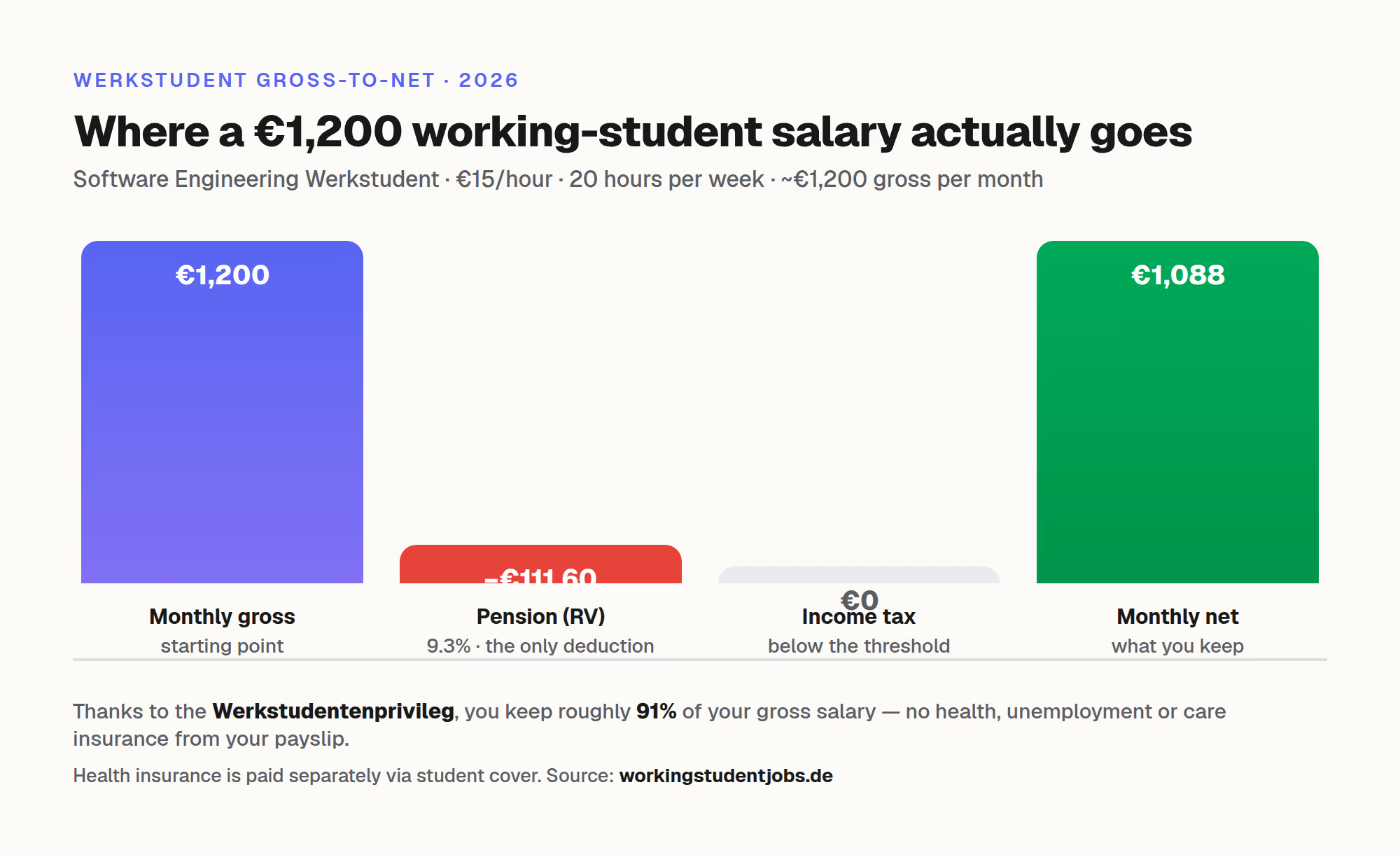
Role: Software Engineering Werkstudent, €15/hour, 20 hours per week Monthly gross: ~€1,200 (assuming ~4.3 working weeks per month)
Deduction | Rate | Amount |
|---|---|---|
Pension insurance (RV) | 9.3% | −€111.60 |
Income tax | 0% (below threshold) | €0 |
Monthly net | ~€1,088 |
At €15/hour for 20 hours per week, you keep roughly 91% of your gross salary.
At Germany's minimum wage in 2026 (€13.90/hour):
Monthly gross: ~€1,112 Pension (9.3%): −€103.42 Income tax: €0 Monthly net: ~€1,009
For your exact numbers based on your hourly rate, hours, and tax class, use the Working Student Tax Calculator.
To see what salaries look like across different cities and fields in Germany, check the Working Student Salary Guide 2026.
Minijob vs Werkstudent: What's the Difference?
A minijob pays up to €603/month (2026 threshold) with no employee social contribution deductions. But minijobs have real limits: no unemployment insurance, no sick pay entitlements, and the €603 ceiling caps your total monthly earnings.
As a Werkstudent, you can earn more and still benefit from the social security exemption. The only deduction is the 9.3% pension contribution. For students who can find a Werkstudent position at typical rates (€14–20/hour, at or above the 2026 minimum wage of €13.90), a Werkstudent contract almost always means higher take-home pay than a minijob. For a side-by-side comparison of both contract types — including visa rules and health insurance implications — see our working student vs minijob guide.
Key Takeaways
The Werkstudentenprivileg exempts you from health, care, and unemployment insurance contributions as long as you work at most 20 hours per week during the semester.
You pay only 9.3% in pension contributions. Below €603/month, even that drops to zero.
The 20-hour limit rises to 40 hours during semester breaks, with a 26-week annual cap.
Health insurance is your responsibility. Most students use the KVdS student rate (~€122–146/month).
Income tax only applies above ~€1,131/month gross in 2026. Most Werkstudenten pay none.
Filing a tax return is optional but often results in a refund.
Calculate your exact take-home pay with the Working Student Tax Calculator. Enter your hourly rate, weekly hours, and city to see your net salary for 2026.
* Some links on this page are advertising or affiliate links. If you use one and buy or complete an offer, we may earn a commission at no extra cost to you. That support helps us keep improving workingstudentjobs.de, and our reviews and recommendations remain independent.
Your Details
Salary Period
Calculation
👑 Top 1%, richer than 99% of students. Basically a CEO with a student ID
Gross Salary
2.500,00 €
Monthly Net Salary
2.057,25 €
You take home 2.057,25 € net from 2.500,00 € gross per month as a Working Student (Werkstudent) in Germany, after taxes and social security.
Monthly Breakdown
Taxes
Social Security
Werkstudent jobs in Berlin paying around €17/h
Your €2,500 a month is about €28.87/h at 20 hours a week. The city figure is the median of listings that state pay.
Keep reading
Frequently Asked Questions
About the author

Dinh Minh (Minton) Vu
Dinh Minh Vu is a software engineer and CS master's student at the University of Passau. As an international student who navigated the German working student system himself, he built workingstudentjobs.de to help other international students find and land Working Student roles in Germany.
Find your next working student job
Browse 1000+ opportunities at top companies across Germany.
Browse jobs