Last verified: June 2026. Written by Dinh Minh Vu (M.Sc. Computer Science, University of Passau) based on §16b AufenthG, Make It In Germany, Berlin LEA, and Studierendenwerke guidance. This is general information, not legal advice. For your specific situation, confirm with your university's International Office or a licensed immigration lawyer (Rechtsanwalt für Ausländerrecht).
How Many Days Can International Students Work in Germany in 2026?
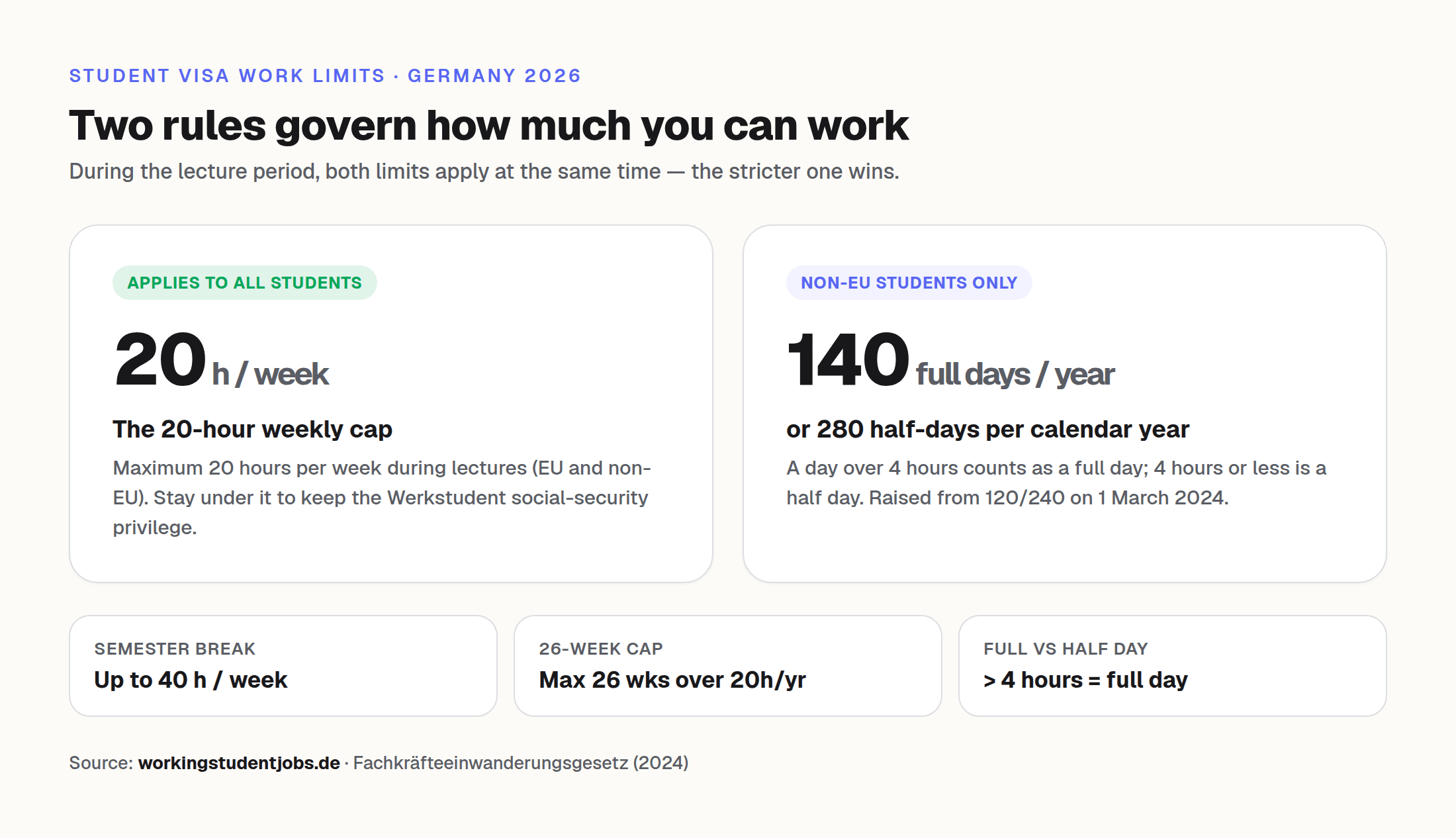
As of June 2026, non-EU students on a §16b student residence permit can work 140 full days or 280 half days per calendar year. During lectures, the 20-hour weekly limit still applies. A day over 4 hours counts as a full day, so shift planning matters.
As a non-EU student in Germany, you can work up to 140 full working days or 280 half working days per year under your student visa. During the lecture period, you are also limited to 20 hours per week. Both limits apply at the same time, and exceeding either one puts your residence permit at risk.
I went through this exact calculation as an international student in Passau. My residence permit was issued while the old "120 days" wording was still in use, and the rules changed to 140 days partway through. That experience is why this guide focuses on the part most articles skip: how the two limits interact, and how the way you arrange your shifts quietly eats your annual day budget.
This guide explains both rules in full, how they interact, what counts and what does not, and what happens if you go over.
Key Numbers at a Glance (2026)
Rule | Limit | Who It Applies To |
|---|---|---|
Weekly hours during lectures | Max 20 hours per week | All students (non-EU and EU) |
Annual working days | 140 full days or 280 half-days per calendar year | Non-EU students only |
Semester break hours | Up to 40 hours per week | All students |
26-week cap (Werkstudentenprivileg) | Cannot exceed 20 h/week for more than 26 weeks per year | All students |
Threshold: full day vs half day | More than 4 hours on a single day = full day | Non-EU students only |
Updated March 1, 2024: The annual limit increased from 120 full days (240 half-days) to 140 full days (280 half-days) under the Fachkräfteeinwanderungsgesetz (Skilled Immigration Act). This change applies retroactively to all current residence permits with the old wording.
What | Until Feb 2024 | From March 2024 (current, 2026) |
|---|---|---|
Full working days per year | 120 | 140 |
Half working days per year | 240 | 280 |
Weekly hours during lectures | 20 hours | 20 hours (unchanged) |
Legal basis | §16b AufenthG | §16b AufenthG (Fachkräfteeinwanderungsgesetz) |
Applies to permits issued before the change? | — | Yes, retroactively |
Who Do These Rules Apply To?
EU and EEA citizens studying in Germany have no work restrictions. You can work as many hours as you want, whenever you want, just like any German student.
Non-EU students (from India, Pakistan, China, Vietnam, Nigeria, the US, and all other third countries) must follow both the 20-hour weekly rule and the 140-day annual limit. These rules apply to students on a student residence permit under Section 16b of the German Residence Act (AufenthG).
According to the DAAD (German Academic Exchange Service), more than 400,000 international students are enrolled at German universities, the majority from non-EU countries. All of them are subject to the rules below.
Who this guide does NOT cover. If you are in Germany on a language-course visa (§16f AufenthG, Sprachkurs) or attending a Studienkolleg preparatory college before formal enrollment, your work rights are typically restricted or excluded entirely, and the 140-day allowance does not automatically apply. This guide is written for degree students enrolled at a recognized university under §16b. If you are still in the pre-arrival phase, our checklist for international students coming to Germany walks through the full sequence before you reach the work-rules stage.
PhD students. If you are enrolled as a doctoral student on a §16b student residence permit, the same 140-day rule applies to you. But if your university employs you as a research assistant (wissenschaftlicher Mitarbeiter) on a formal employment contract, you are usually on a work permit rather than a student permit, and the day limits do not apply. Check the type of your residence permit, not your academic title.
What Are the Two Work Rules for International Students in Germany?
There are two separate limits, enforced by two different authorities.
The 20-hour weekly rule is a labor rule. It is enforced by the German pension authority (Deutsche Rentenversicherung) through your employer's social security filings. Exceeding it causes you to lose the Werkstudentenprivileg, the social security exemption that reduces your deductions to only 9.3%.
The 140-day annual rule is a visa rule. It is enforced by the Ausländerbehörde (foreigners' office) and is written into your residence permit. Exceeding it, without prior authorization, is unauthorized employment and can result in your permit not being renewed.
Both limits apply to your total hours across all employers combined, not per individual employer.
How Many Hours Can a Non-EU Student Work Per Week in Germany? (The 20-Hour Rule)
During the lecture period (Vorlesungszeit), you may work a maximum of 20 hours per week as a working student (Werkstudent). This keeps your studies as the primary purpose of your stay.
The 20-hour rule is not enforced per employer. If you have a Werkstudent position at a tech company and a weekend shift at a cafe, those hours are added together. Ten hours at each employer equals 20 total, which is exactly at the limit. Twelve hours at one and twelve at another means 24 total, which puts you over.
The 20-hour rule applies as a weekly average, not as a strict weekly hard cap. A single week at 22 hours because of a project crunch is not automatically a violation. What matters is whether your consistent work pattern stays within the limit.
During semester break (Vorlesungsfreie Zeit), you can work up to 40 hours per week. Your working student status continues during the break as long as you remain enrolled at your university.
What happens if you exceed 20 hours per week?
If you consistently work more than 20 hours per week during the lecture period, you lose the Werkstudentenprivileg. Your employer must deduct the full social security rate, roughly 20 percent of gross salary, retroactively. This covers health, care, and unemployment insurance that the privilege normally exempts you from.
There is a second consequence specific to health insurance: if you work more than 20 hours per week, you are no longer covered by student health insurance (KVdS). You must switch to employee health insurance instead, which is more expensive. The exception is temporary jobs lasting no more than three months.
The Ausländerbehörde can also view consistent over-hours as evidence that work, not study, has become the primary purpose of your stay, which can contribute to a permit renewal refusal.
For a detailed breakdown of social security contributions, deductions, and net salary calculations, see our working student tax guide. To calculate your exact take-home pay, use the salary calculator.
What Is the 140-Day Rule for Students in Germany? (The Annual Visa Limit)
Non-EU students on a §16b student residence permit can work up to 140 full working days or 280 half working days per calendar year without needing additional authorization. The calendar year runs from January 1 to December 31, and the budget is not prorated from your permit start date: if your permit starts in September, you still have the full 140-day budget available through December 31. The Berlin Landesamt für Einwanderung confirmed this in official guidance.
This rule is written into §16b, Paragraph 3 of the German Residence Act, and was raised from 120/240 days to 140/280 days on March 1, 2024, under the Fachkräfteeinwanderungsgesetz. The official legal text is at §16b AufenthG. The German federal government's guidance portal, Make It In Germany, confirms the current rules.
Unused days do not carry forward. If you use 90 days in one calendar year, the budget resets to a fresh 140 days on January 1 of the next year. You cannot "save" unused days from a previous year.
What is a full day vs a half day?
A full working day is any calendar day on which you work more than 4 hours. It uses one day from your 140-day budget.
A half working day is any calendar day on which you work up to 4 hours. Working just one hour on a day still counts as one half-day used. It uses one slot from your 280 half-day budget.
The key rule that surprises most students: if you work 5 hours on a Monday, that counts as a full day, not a half-day. The threshold is 4 hours. Anything above 4 hours on a single calendar day consumes a full day from your budget, regardless of whether it was 5 hours or 10 hours.
You can mix full days and half-days freely. One full day equals two half-days. If you have used 60 full days and 80 half-days, you have consumed the equivalent of 100 full days and have 40 full days remaining.
The Studierendenwerke (German student welfare organization) documents this counting method in their official guide.
What does NOT count toward the 140-day limit?
Certain types of work are fully exempt and do not reduce your annual budget:
Mandatory curriculum internships (Pflichtpraktikum). If your degree program formally requires an internship, those days are exempt. This applies only to internships that are a documented requirement of your degree, not internships you choose to do voluntarily.
Bachelor's and Master's thesis work at a company. If you complete your final thesis at an external company or research institute, those days do not count.
University-affiliated roles. Working as an academic or student assistant (Hiwi or SHK) at your university, at a Studierendenwerk, or at a student union (AStA) is exempt. Jobs with a very close institutional connection to your university also fall under this exemption.
Sick days, public holidays, and vacation days. Only days you actually work count toward the limit. A sick day is not a working day and does not reduce your budget.
Does a minijob count toward the 140-day limit?
Yes. A minijob (geringfügige Beschäftigung, capped at €603 per month in 2026) counts toward the 140-day annual limit exactly like a Werkstudent position. The low monthly earnings cap does not exempt the days from your visa budget. A student who holds both a Werkstudent job and a minijob draws from the same shared 140-day pool. If you are deciding between contract types, our Werkstudent vs minijob comparison explains when each one makes sense.
What DOES count toward the 140-day limit?
All employment at external employers counts: Werkstudent positions, minijobs, part-time jobs, temporary work, and voluntary internships at companies outside the university.
Your 140-day budget is shared across all employers combined. It is 140 days total per year, not 140 days per job. If you hold two Werkstudent positions simultaneously, both draw from the same pool.
How the Two Rules Interact: A Worked Calendar Example
The 20-hour weekly rule and the 140-day annual rule operate independently, but both apply at the same time. Here is a complete calendar example for a winter-semester student.
Scenario: Student starts a Werkstudent position in October. Lectures run October to mid-February (20 weeks). Summer semester runs April to mid-July (20 weeks). Two semester breaks: mid-February to late March (6 weeks) and late July to September (8 weeks).
Winter semester (October to mid-February, 20 weeks):
4 days per week, 5 hours per day = 20 hours per week ✓
Each 5-hour day is over the 4-hour threshold = full day
4 full days × 20 weeks = 80 full days used
February break (6 weeks, full-time):
5 days per week, 8 hours per day = 40 hours per week ✓
5 full days × 6 weeks = 30 full days used
Summer semester (April to mid-July, 20 weeks):
4 days per week, 5 hours per day = 20 hours per week ✓
4 full days × 20 weeks = 80 full days used
Running total after summer semester: 80 + 30 + 80 = 190 full days, which exceeds the 140-day annual budget by 50 days.
This student would need to either reduce semester hours, or take the full-time break weeks off, or apply for additional authorization from the Ausländerbehörde before exceeding the limit.
The key insight: A typical Werkstudent working through both semesters plus full-time semester breaks in the same calendar year is at serious risk of exceeding the 140-day limit. Planning matters.
Why Does Your Weekly Schedule Affect How Many Visa Days You Use? (The Schedule Trap)
Two students working exactly the same 20 hours per week can consume completely different amounts of their 140-day annual budget, purely because of how their shifts are arranged. This is the single most counterintuitive part of the 140-day rule.
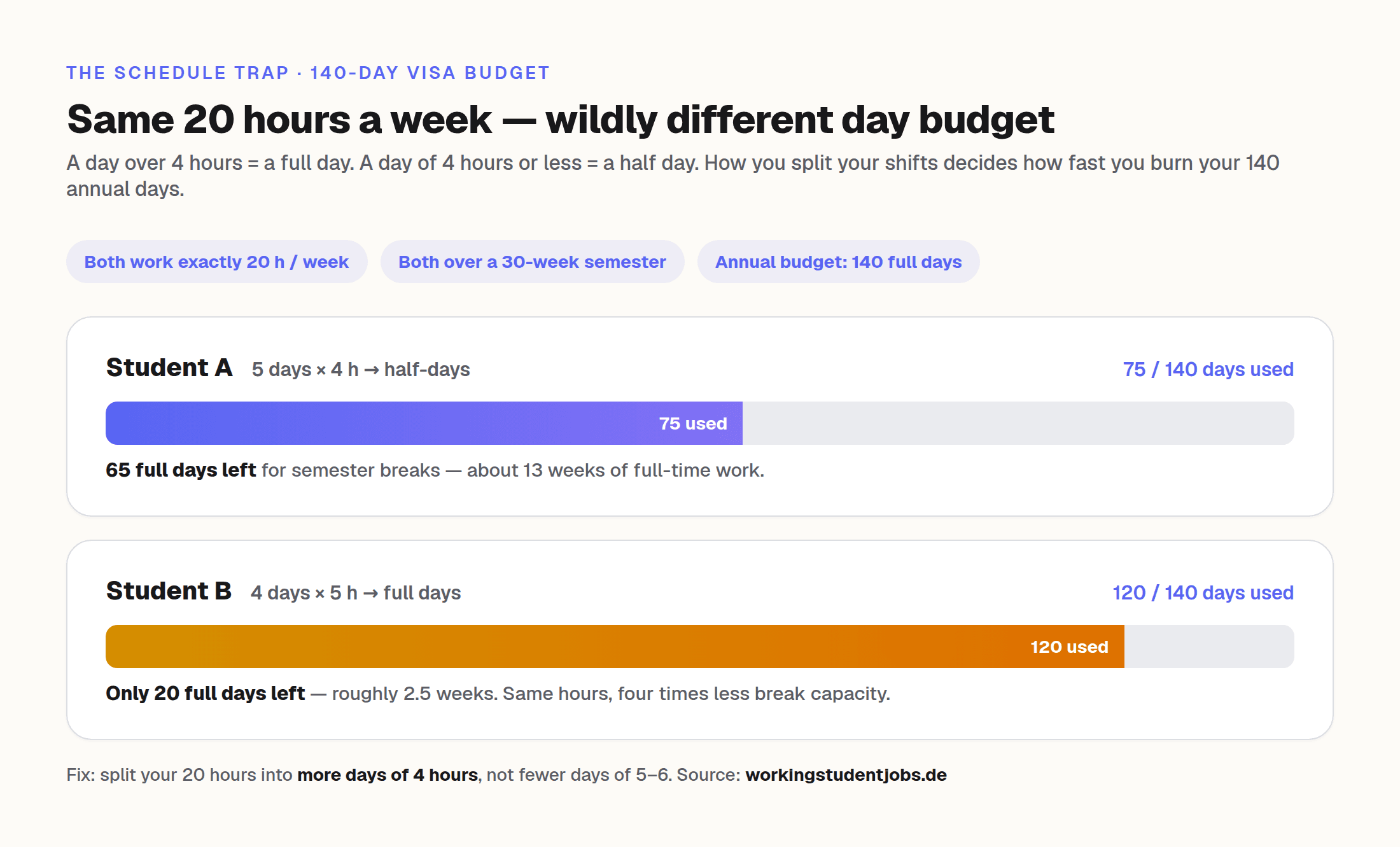
Student A works 5 days a week, 4 hours per day = 20 hours per week. Each day is exactly 4 hours or less, so each counts as a half-day. Over a 30-week semester, that is 150 half-days, equivalent to 75 full days used. Student A has 65 full days remaining for semester breaks.
Student B works 4 days a week, 5 hours per day = 20 hours per week. Each day is 5 hours, over the 4-hour threshold, so each counts as a full day. Over the same 30-week semester, that is 120 full days used. Student B has only 20 full days remaining, which is roughly 2.5 weeks of full-time work during breaks.
Same total hours worked per week. Completely different impact on the annual visa budget.
If you want to preserve your day budget for semester breaks, ask your employer if you can arrange your 20 hours into more days of 4 hours rather than fewer days of 5 or 6 hours. Many Werkstudent positions are flexible enough to accommodate this, and it can add weeks to your working capacity during summer and winter breaks.
Can I Work Full-Time During Semester Break in Germany?
Yes. During semester break (Vorlesungsfreie Zeit), you can work up to 40 hours per week under the labor rule. Your Werkstudentenprivileg continues, and no additional authorization is needed.
However, the 140-day annual limit still applies without any pause or suspension during semester breaks. Every day you work during a break, whether 4 hours or 10 hours, is a day from your annual budget.
If you arrive at the summer break having already used 120 of your 140 days during the semester, you have exactly 20 full days, roughly 4 weeks of full-time work, remaining before you hit your ceiling.
Track your days from January 1. Do not wait until July to calculate how many days you have left.
What Is the 26-Week Rule for Werkstudenten?
There is a third limit that applies specifically to Werkstudent social security status, separate from both the 20-hour weekly rule and the 140-day visa rule.
You cannot work more than 20 hours per week for more than 26 weeks in any 12-month period. This cap protects your right to the Werkstudentenprivileg. Only weeks in which you actually exceed 20 hours count toward the 26-week total.
This matters mainly for semester-break work. Working exactly 20 hours per week during lectures does not count toward the cap, because that is not more than 20 hours. But every full-time break week at 40 hours does count. Germany's semester breaks total roughly 22 weeks per year, so a student who works full-time through every single break is already close to the 26-week ceiling before adding anything else.
The risk case is combining full semester-break employment with weeks where you also consistently push above 20 hours during lecture periods. Stack enough of those over a rolling 12-month window and you can cross 26 weeks, which triggers retroactive loss of the privilege for the affected period. The source for this cap is §8 SGB IV together with Deutsche Rentenversicherung administrative guidance.
Do My Hours Combine Across Multiple Employers in Germany?
If you hold more than one job simultaneously, all your hours are added together for both the 20-hour and 140-day assessments.
Two Werkstudent jobs of 12 hours each equal 24 combined hours per week, which puts you over the 20-hour lecture-period limit, even though each individual contract looks compliant.
For the 140-day annual limit: your budget is shared across all employers. Working 3 days at one company and 2 days at another in the same week uses 5 days of your annual budget, not 3 and 2 separately.
Your employers are not automatically aware of each other's schedules. You are responsible for tracking your combined total. If you work for multiple employers, disclose this to each one so they can account for it in their records. Jobbatical's immigration law analysis confirms that "the annual day budget applies to one shared annual budget, not per employer." Combined hours also matter for your take-home pay across jobs: see our working student salary benchmarks for what to expect per field and city.
What Happens If You Exceed the Limits?
Exceeding the 140-day limit without prior Ausländerbehörde authorization is unauthorized employment and can result in your residence permit not being renewed. There is no retroactive approval. The detail below explains both the visa and the social-security consequences.
Exceeding the 140-day annual limit
If you need to work more than 140 full days in a calendar year, you must apply for authorization from your local Ausländerbehörde before you exceed the limit. Retroactive approval is not possible under §4a of the Residence Act.
Authorization is not instant. Processing commonly takes around 4 to 8 weeks and varies by city, so a student who realizes in late October that they will go over cannot wait until December to apply. Start the request as soon as you can see the limit approaching.
Without prior authorization, exceeding the limit constitutes unauthorized employment. The practical consequences depend on severity and how it is discovered, but they can include:
Refusal to renew your residence permit when it expires
In more serious cases, earlier revocation of your permit
Your employer may also face fines for knowingly employing someone beyond their authorized work limit
If you realize you are approaching 140 days before year-end, contact your university's International Office or your local Ausländerbehörde as early as possible. Do not wait until you have already exceeded it. Your employer can also file the authorization request on your behalf.
On permit renewal itself: renewal is handled by your local Ausländerbehörde, not automatically. Most cities recommend applying around 3 months before your current permit expires, and some have long appointment waiting times, so book early. A clean work-limit record makes this process far smoother.
Exceeding 20 hours per week
The immediate consequence is loss of the Werkstudentenprivileg. Your employer recalculates your social security contributions as a regular employee, with retroactive deductions for health, care, and unemployment insurance. This can produce a significant unexpected deduction from your salary.
The Ausländerbehörde can also treat sustained over-hours as evidence that employment, not study, has become your primary activity. This can contribute to a permit renewal refusal.
Exceeding 20 hours and health insurance
If you consistently work more than 20 hours per week, you are no longer covered by student health insurance (Krankenkasse des Studierenden, KVdS). You must arrange regular employee health insurance instead. The Studierendenwerke advises: "Those with family insurance should seek advice from their health insurance company before starting work in order to clarify their insurance cover." Exception: temporary jobs lasting no more than three months do not trigger this switch.
Can You Work Freely in Germany After Graduating? (The 18-Month Job-Seeker Visa)
Once you finish your degree, you are eligible to apply for an 18-month job-seeker visa (Aufenthaltstitel zur Arbeitssuche, §20 AufenthG). During this period, you can work freely, without the 20-hour or 140-day restrictions. A Werkstudent who moves directly to a job-seeker visa and then to a work contract or EU Blue Card removes all of these limits permanently.
Many companies that hire Werkstudenten offer full-time roles to their best working students after graduation. This makes the Werkstudent path one of the most direct routes from student visa to long-term work authorization in Germany. See our best companies for working students guide for employers known to convert their Werkstudenten to full-time roles.
Can I Work Freelance or Self-Employed on a §16b Student Visa? (Bachelor, Master, PhD)
Self-employment is not automatically permitted under §16b: you need explicit written permission from the Ausländerbehörde (ABH), and that permission must appear on your residence permit itself, typically as the condition "selbstständige Tätigkeit gestattet" (self-employment permitted). A verbal confirmation or email is not sufficient. Your standard student permit only covers employment as a worker (Werkstudent, minijob, part-time), not freelance or business activity. The rule is the same regardless of degree level — Bachelor, Master, and PhD students enrolled under §16b face the identical restriction; your degree does not grant or remove the right. The self-employment authorization is granted at the discretion of the Ausländerbehörde under §21 AufenthG, attached to your existing §16b study permit.
To apply, submit a written request to your local ABH, usually including a description of the planned activity, evidence of existing or prospective clients (or a short business plan), and proof of enrollment. Approval is not guaranteed: the ABH weighs whether the self-employment would interfere with your studies, and modest freelance work in your field (for example, a software student taking occasional development contracts) is more likely to be approved than a full commercial operation. The official Make It In Germany self-employment guidance covers the options.
Crucially, self-employment days count toward your 140-day annual budget exactly like employment days. ABH permission to freelance does not grant any extra days. The tax-registration side (Freiberufler vs Gewerbetreibender, the Steuernummer and Fragebogen zur steuerlichen Erfassung via ELSTER, and the Kleinunternehmerregelung small-business VAT exemption below €22,000 revenue) is a separate process; our working student tax guide covers it in full.
Practical Tips for Staying Compliant
Track your days from January 1. Keep a simple spreadsheet with date, employer, and hours worked each day. Do not rely on your employer to do this automatically. A minimal tracker looks like this:
Date | Employer | Hours worked | Day type | Running total (full days) |
|---|---|---|---|---|
Jan 8 | TechCo | 5 | Full | 1 |
Jan 9 | TechCo | 4 | Half | 1.5 |
Jan 11 | Cafe | 3 | Half | 2 |
Know the 4-hour threshold. Before accepting a shift, check whether it pushes you past 4 hours on that day. A 4-hour shift = half-day used. A 4.5-hour shift = full day used.
Tell each employer about your other jobs. They need the full picture to track combined hours correctly. This protects both you and them.
Act before you hit 140 days. If you see you will exceed the limit before December 31, contact your Ausländerbehörde or International Office with enough lead time for the approval process. Apply early.
Check your permit wording. If your residence permit still says "120 days or 240 half-days," you are legally entitled to the updated 140/280-day limit since March 2024. The Berlin LEA confirmed you do not need to get the wording amended.
Set a mid-October reminder. That is roughly 9 months into the year. It is the right moment to check how many days you have left and plan your year-end work schedule.
How Does Germany's Student Work Limit Compare Internationally?
Germany's 140-day allowance is one of the more generous student work frameworks among major study destinations. The table below compares the standard term-time limit for non-citizen degree students in 2026.
Country | Term-time work limit | Notes |
|---|---|---|
Germany | 20 h/week + 140 full days/year | Full-time (40 h/week) during semester breaks |
United Kingdom | 20 h/week | Degree-level students; 10 h/week below degree level |
Canada | 24 h/week off-campus | Raised from 20 h in November 2024; unlimited during scheduled breaks |
Australia | 48 h/fortnight (~24 h/week) | Applies during study sessions |
Netherlands | 16 h/week year-round | Or full-time only in June–August, not both |
United States | 20 h/week on-campus only | F-1 visa; off-campus work needs CPT/OPT authorization |
Germany is unusual in pairing a weekly hour cap with a separate annual day budget. Most countries enforce a weekly cap alone. That extra day budget is exactly why shift planning (the schedule trap above) matters so much in Germany specifically, and why two students working the same hours can use very different shares of their allowance.
How Much Can You Earn Within the 20-Hour Limit? (2026 Minimum Wage)
The work limits set how much you can work; the minimum wage sets the floor on what you earn for it. As of January 2026, the German statutory minimum wage is €13.90 per hour. No employer, including a Werkstudent or minijob position, may legally pay less.
At 20 hours per week, the minimum wage works out to roughly €1,205 per month gross. Most Werkstudent roles in fields like software, data, engineering, and finance pay well above the minimum, commonly €15–25 per hour, so a 20-hour week in a degree-relevant role often lands between €1,300 and €2,100 gross per month.
Two thresholds shape what you actually keep:
Annual tax-free allowance (Grundfreibetrag): €12,348 in 2026. If your total annual income stays below this, you owe no income tax, and any wage tax withheld during the year is refundable through a tax return.
Minijob ceiling: €603 per month. Earn at or below this in a minijob and the income arrives essentially net, but those working days still count toward your 140-day budget.
Thanks to the Werkstudentenprivileg, social-security deductions on a Werkstudent salary stay at roughly 9.3% (pension only) as long as you respect the 20-hour rule. To see your exact take-home pay for a given hourly rate and hours, use our working student salary calculator. For field-by-field and city-by-city pay benchmarks, browse our live salary data by city and field or read our working student salary guide.
Finding English-Speaking Working Student Jobs in Germany
Understanding the rules is the first step. The next is finding a position that fits your schedule and study commitments.
Over 70 percent of working student listings on this platform are open to English-speaking candidates in fields such as software engineering, data science, marketing, and finance. Browse English-speaking working student jobs currently open on the platform.
For a full guide to the job search, CV, and application process as an international student, read how to find a working student job in Germany. For CV-specific advice tailored to German employers and the Werkstudent context, see our working student CV guide for Germany.
To understand what hourly rates to expect in your field and city, check our working student salary benchmarks.
To compare working student positions against internships and minijobs, see our overview of working student jobs in Germany.
Once you have an offer, you will need a German bank account for payroll, because most German employers cannot pay to a foreign IBAN. A free, English-language account like bunq* can be opened from your phone in minutes without an Anmeldung, so you are ready before your first payday. See our best bank account comparison for working students for how it stacks up against N26, Deutsche Bank, and others.
Written by Dinh Minh Vu, M.Sc. Computer Science student at the University of Passau and founder of workingstudentjobs.de. I came to Germany as an international student and navigated the §16b work rules, the Werkstudentenprivileg, and the permit process firsthand. This guide reflects that experience plus the official sources cited throughout.
* Some links on this page are advertising or affiliate links. If you use one and buy or complete an offer, we may earn a commission at no extra cost to you. That support helps us keep improving workingstudentjobs.de, and our reviews and recommendations remain independent.
Keep reading
Frequently Asked Questions
About the author

Dinh Minh (Minton) Vu
Dinh Minh Vu is a software engineer and CS master's student at the University of Passau. As an international student who navigated the German working student system himself, he built workingstudentjobs.de to help other international students find and land Working Student roles in Germany.
Find your next working student job
Browse 1000+ opportunities at top companies across Germany.
Browse jobs