Last checked: July 2026. The prices below reflect what I saw then, and prepaid offers move fast.
When I moved to Germany from Vietnam, the arrival eSIM I'd set up at home did exactly one job well: it gave me data the second I landed so I could find my train and message my landlord. What it did not give me was a German phone number — and I hit that wall fast. My bank wanted a German mobile for its SMS-TAN. The Bürgeramt confirmation for my Anmeldung came by text. Every landlord wanted to reach me on a local number, not a foreign one. A travel eSIM cannot fix any of that. This guide is the part the arrival checklist deliberately leaves for later: getting a real German number and a local SIM that's cheap for the long run.
If you haven't landed yet, start with the connectivity section of the 7-days-before-arrival checklist — an arrival eSIM is your bridge. Come back here once you're on the ground and ready for a proper German line.
TL;DR
A travel/arrival eSIM gives you data, not a German number. For a German mobile number you need a German SIM or eSIM.
Get a prepaid SIM first. It needs only your passport — no Anmeldung, no bank account, no SCHUFA.
German law (since 2017) requires ID verification on every SIM, even a €10 supermarket one. You verify by video call, NFC eID, in-store, or during eSIM setup.
A temporary address (hostel, Airbnb, a friend's place) is fine at sign-up. You do not need your Anmeldung yet.
Pick your provider by network, not just price: congstar rides Telekom (best coverage), Lidl Connect rides Vodafone, Aldi Talk and Lebara ride o2. Lebara is the only one with a fully English website and support.
Switch to a contract later, once you have your Anmeldung, a German IBAN, and a SCHUFA history — that's when contracts get cheaper per gigabyte.
Do you actually need a German phone number as a student?
Yes. Within your first two weeks, a German number stops being convenient and starts being a blocker. Data alone won't get you through setup.
Here's where a German mobile number is quietly required:
Opening a bank account. Most German banks and neobanks send a login or payment confirmation (SMS-TAN) to a mobile number, and several expect a German one. A German IBAN is the thing that unlocks rent, deposit, and salary — see how to open a German bank account without Anmeldung — and a working number smooths that whole flow.
Your Anmeldung. Many Bürgeramt booking systems and confirmations run over SMS, and the registration form itself asks for a contact number. If you're new to the process, start with the Anmeldung guide.
Landlords and flat viewings. German housing moves over phone and WhatsApp. A foreign number gets ignored or costs the landlord to call.
Two-factor everything. Insurance portals, university logins, delivery lockers, and government services increasingly text a code to your phone.
Job callbacks. Recruiters call. A German number reads as "already here and reachable."
A foreign SIM roaming in Germany technically works, but it's expensive, some SMS-TAN systems reject non-German numbers, and you look like you're still abroad. Get a local number early.
Prepaid or contract — which should a student get first?
Start prepaid. Move to a contract only after you're settled. The reason is documents, not preference: a contract needs your Anmeldung, a German IBAN for direct debit, and a passing SCHUFA credit check — none of which you have on day one. Prepaid needs none of them.
Prepaid (Prepaid-Tarif) | Contract (Vertrag) | |
|---|---|---|
Anmeldung needed? | No | Yes, almost always |
German IBAN needed? | No (top up by card/cash) | Yes — monthly direct debit (Lastschrift) |
SCHUFA credit check? | Never | Yes — hard to pass with no German history |
Commitment | None, cancel anytime | Often 24 months |
Price per GB | Slightly higher | Cheaper at higher data tiers |
Best for | Your first weeks and months | Once you have address + bank + SCHUFA |
New arrivals fail contract sign-ups on the SCHUFA check and the Anmeldung requirement — you have neither on day one. Prepaid sidesteps all of it: passport, a top-up, done. Treat prepaid as your first 2–6 months, then reassess.
What do you need to register a German SIM card?
A valid passport or ID, plus any temporary address. Since 1 July 2017, every SIM in Germany — even the cheapest supermarket one — must be tied to a verified identity before it activates. The rule sits in §172 TKG (originally §111 TKG, from the 2016 anti-terror information-sharing law), and the Bundesnetzagentur enforces it. That plastic SIM from the checkout does nothing until you complete verification (Freischaltung).
What you'll need:
Your passport (or EU national ID). Non-EU students may be asked for the residence permit (Aufenthaltstitel) once they have one, but a passport is enough to get started on arrival.
An address — and this is the part people over-think. A hostel, Airbnb, or a friend's address is accepted. You do not need your Anmeldung to buy a prepaid SIM. Update the address later in the provider's app once you've registered.
You'll verify your identity in one of four ways, all common in 2026:
VideoIdent — a short video call where you hold up your passport. Fully online.
eID / NFC — tap your passport or ID chip against your phone. Fastest if your document supports it.
In-store (PostIdent) — show your passport at a shop or post office counter.
During eSIM setup — some providers fold verification into the digital activation flow.
I did mine by VideoIdent from my kitchen table the evening I landed — about ten minutes end to end. The only snag was lighting: the agent needs to read the hologram on your passport, so sit somewhere bright and have the physical document, not a photo, in hand.
Which prepaid SIM is best for international students?
Quick answer: Lebara if you want English support, congstar for the best coverage, Aldi Talk for the lowest price. All the discount brands are MVNOs: they rent capacity from one of the three physical networks, so the brand you pick is really a bet on a network.
In connect's 2026 Netztest, Telekom won for the 15th year running with a clear coverage lead, while Vodafone and o2 tied for second. Telekom's edge shows most outside the big cities — so if you'll spend time in smaller towns, a Telekom-network brand like congstar is the safest bet.
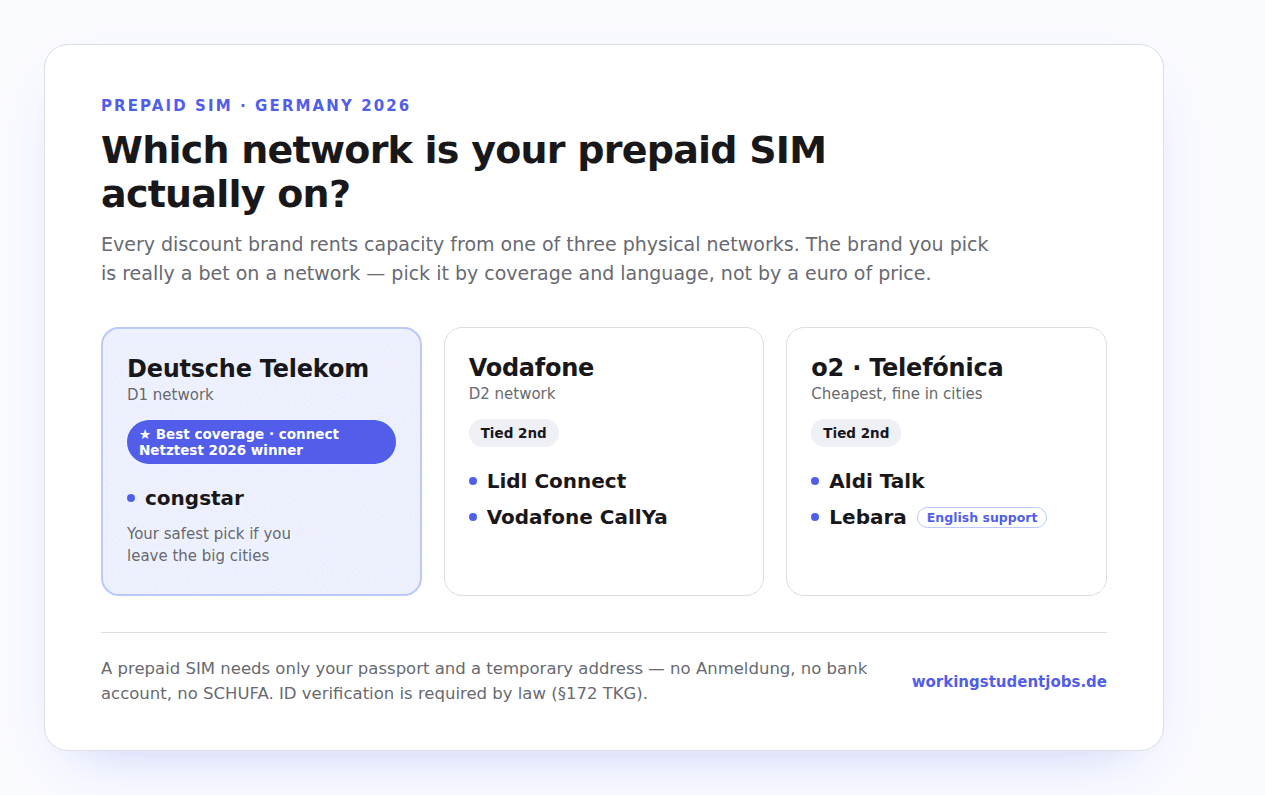
Provider | Runs on | English support? | Best for |
|---|---|---|---|
congstar | Telekom (D1) | Limited | Best coverage, including smaller towns |
Lidl Connect | Vodafone (D2) | Limited | Solid coverage, buy at any Lidl |
Aldi Talk | o2 (Telefónica) | Limited | Cheapest, everywhere in cities, huge user base |
Lebara | o2 (Telefónica) | Yes — full English site + support | No-German setup and international calling |
Vodafone CallYa | Vodafone (D2) | Some | Instant eSIM straight from Vodafone |
A few honest notes on price and mechanics:
When I price-checked in 2026, prepaid bundles had dropped to roughly €0.70–€1.00 per GB — Germany is no longer expensive here. Expect current offers around 20–30 GB for €5–€14 per cycle; check the live price before you buy, because promos rotate.
Discounter cycles run every 28 days, not monthly. Aldi Talk and Lidl Connect bill 13 times a year, so a "€10/month" plan is really ~€130/year.
5G is standard on most prepaid plans now, but budget brands cap speed (often 25–100 Mbit/s). Fine for a phone; only matters if you tether a laptop hard.
If your German is thin, Lebara is the path of least resistance — English throughout — and its international rates suit calling home.
Can you get a German eSIM as a prepaid customer?
Yes — and it's the fastest way to a German number with no plastic SIM and no shipping wait. Vodafone CallYa, o2, Telekom, and Aldi Talk all offer prepaid eSIMs you activate from the app.
Don't confuse this with the travel eSIM from the arrival guide. They solve different problems:
A travel/arrival eSIM (the kind you set up at home before flying) gives you roaming data on landing. It usually has no German number, or a throwaway one — it's a data bridge.
A German prepaid eSIM gives you a real, keep-it German mobile number on a German network. This is what banks, the Bürgeramt, and landlords expect.
If your phone has a second eSIM slot, a neat setup is to keep your home SIM for authentication codes from your home country and add a German prepaid eSIM for your German number. Best of both, no swapping.
When should you switch to a contract?
Once you have all three: an Anmeldung, a German IBAN, and a few months of SCHUFA history. Before that, a contract will likely be rejected or hit you with a deposit.
A contract makes sense when:
You're staying long enough to justify a 24-month term (check whether the term or an early-exit clause fits your study plan).
You want more data per euro — contracts pull ahead at the 20 GB+ tiers.
You want a bundled new phone, though buying the handset outright is often cheaper overall.
Until then, prepaid keeps your number, your money, and your options open. Many students never switch at all — modern prepaid data is cheap enough that a contract's only real edge is a subsidised phone.
Get connected in your first week: the sequence
If you want a simple order of operations once you land:
When | Do this |
|---|---|
Landing day | Your arrival eSIM already has you online. Find your train, message your landlord. |
Day 1–2 | Buy or activate a German prepaid SIM/eSIM (passport + hostel address). Verify by VideoIdent or NFC. You now have a German number. |
Day 2–3 | Use that number to open or finish setting up your German bank account — SMS-TAN now works. |
First 2 weeks | Book your Anmeldung; your German number is on the form and gets the confirmation. |
Month 2–6 | Reassess. If you're settled with Anmeldung + IBAN + SCHUFA, compare a contract. If not, prepaid is doing the job. |
Do the number early. Almost every other setup step in Germany quietly assumes you already have one — and the students who get it on day one stop hitting invisible walls that slow everyone else down.
This is a personal playbook from my own move, not official guidance. Prices, promotions, and provider terms change — confirm anything time-sensitive with the provider and the Bundesnetzagentur before you act.
* Some links on this page are advertising or affiliate links. If you use one and buy or complete an offer, we may earn a commission at no extra cost to you. That support helps us keep improving workingstudentjobs.de, and our reviews and recommendations remain independent.
Frequently Asked Questions
About the author

Dinh Minh (Minton) Vu
Dinh Minh Vu is a software engineer and CS master's student at the University of Passau. As an international student who navigated the German working student system himself, he built workingstudentjobs.de to help other international students find and land Working Student roles in Germany.
Find your next working student job
Browse 1000+ opportunities at top companies across Germany.
Browse jobs