Remote working student jobs are legal and common in Germany, but "remote" almost always means working from your German apartment, not from anywhere in the world. A Werkstudent contract is a German employment relationship tied to German social security, so it stays anchored to the country even when it lets you skip the commute. When I first searched for one, I assumed remote meant I could take the job home to another country over semester break. It does not, and getting that wrong can quietly cost you your visa or your tax status.
Once you understand that distinction, remote working student roles become one of the best setups a student in Germany can land: no commute, flexible hours around lectures, and access to companies in cities you do not live in. This guide covers what "remote" legally means for a Werkstudent, how common these jobs actually are (with numbers from our own listings), which fields hire remotely, the trap that catches international students, and how to filter for genuine roles.
Are remote working student jobs legal in Germany?
Yes. Nothing in German law forces a working student to sit in an office. Where you physically work is a contract matter between you and your employer, not a legal restriction. But two rules apply to a remote Werkstudent exactly as they do to an on-site one:
The 20-hour rule. During the lecture period you may work at most 20 hours per week across all jobs combined. Remote work does not relax this; if anything it makes overworking easier because the laptop is always there. Staying under 20 hours is what preserves your Werkstudentenprivileg, the exemption from health, nursing, and unemployment contributions.
Physical residence in Germany. Your Werkstudent status and student health insurance are tied to being enrolled and resident in Germany. The employer runs German payroll and pays into German pension insurance on your behalf. That machinery only works while you are actually in the country.
So a remote Werkstudent job is completely legal. What is not legal, or at least not simple, is doing that job from outside Germany, which is where most people go wrong.
How common are remote working student jobs in Germany?
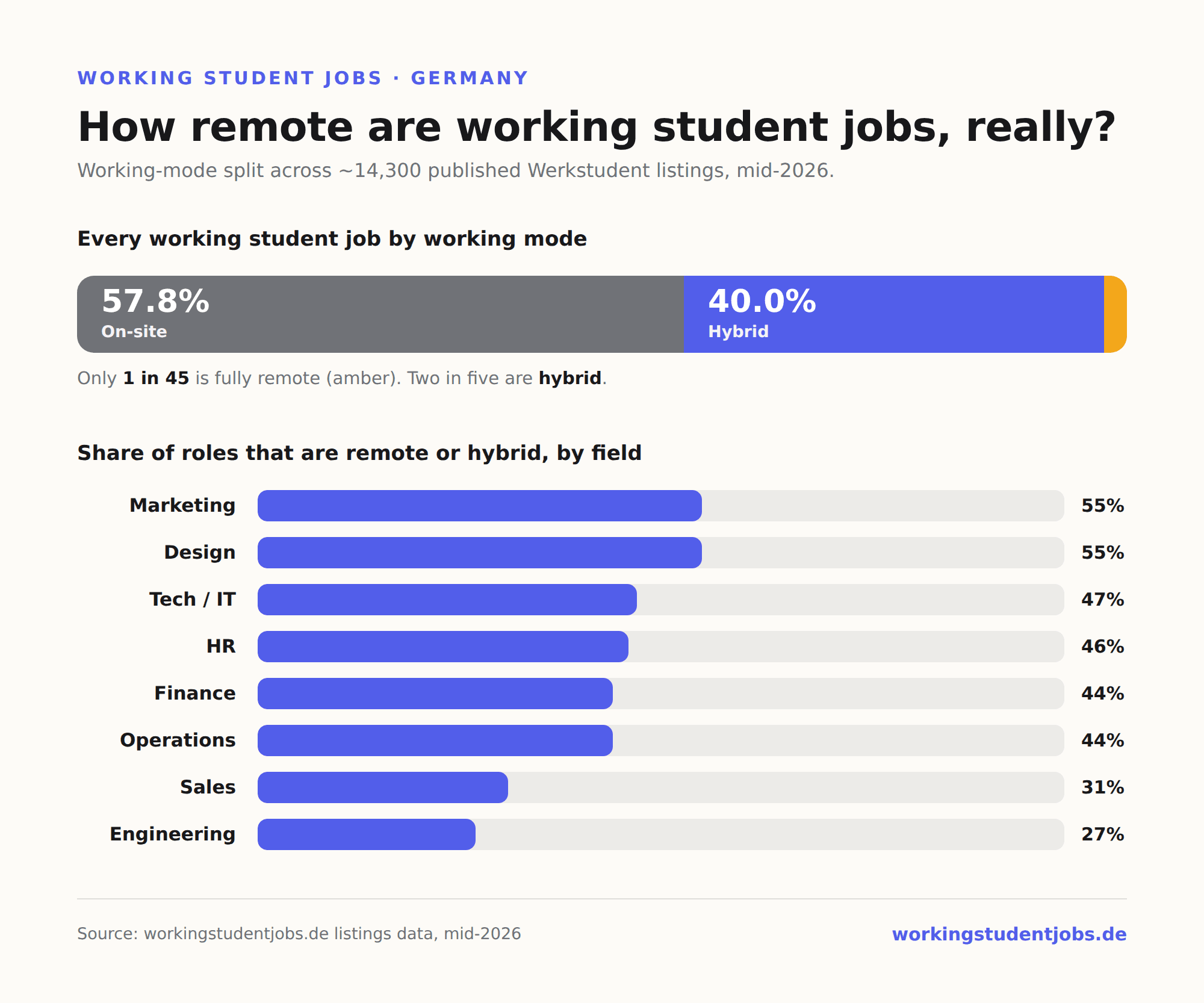
Less common than the hype suggests, and this is where our own data is blunt. Of the roughly 14,300 published working student listings on workingstudentjobs.de in mid-2026, the working-mode split is:
Working mode | Share of working student jobs |
|---|---|
On-site | 57.8% |
Hybrid | 40.0% |
Fully remote | 2.2% |
Read that again: only about 1 in 45 working student jobs is fully remote. Two in five are hybrid, which is what most listings mean when they say "remote." If your plan depends on never setting foot in an office, you are fishing in the smallest pond. If you are happy with one or two office days a week, the market opens up enormously.
The share also depends heavily on your field. Here is how often working student roles in each field are remote or hybrid rather than strictly on-site, from the same dataset:
Field | Remote or hybrid |
|---|---|
Marketing | 55% |
Design | 55% |
Tech / IT | 47% |
HR | 46% |
Finance | 44% |
Operations | 44% |
Sales | 31% |
Engineering | 27% |
The pattern is intuitive: the more digital and screen-based the work, the more likely it can be done from home. Engineering sits at the bottom because so much of it needs labs, hardware, or a plant.
Can international students work a remote Werkstudent job from abroad?
Generally no, and this is the single most expensive mistake to get wrong. For non-EU students the residence-permit conditions add a second layer on top of the 20-hour rule: the 140 full days (or 280 half days) per year your permit allows under §16b AufenthG. This limit counts days worked in Germany, it is separate from the weekly hour rule, and you have to respect both independently.
The clean rule of thumb: treat a remote Werkstudent job as a German job you happen to do from your German apartment.
The trap is geography. If you take a "remote" job and then work it from your home country over the winter break, you create three problems at once:
Tax residency. Working from abroad can shift where your income is taxable, and your German employer is not set up to handle foreign payroll.
Social security. The Werkstudentenprivileg assumes German employment on German soil. Working long stretches abroad can break that assumption.
Visa conditions. Your residence permit permits work in Germany. Days worked from another country do not neatly fit the 140-day framework, and long absences can raise questions about whether Germany is still your center of life.
Occasional days from abroad are a grey area best cleared with your employer's HR and, if in doubt, the Ausländerbehörde. Do not assume "remote" means "portable across borders." It rarely does on a student permit.
Are remote working student jobs fully remote or hybrid?
Mostly hybrid, as the 40%-vs-2.2% split above shows. Most listings that say "remote" mean one or two office days a week, the rest from home. Fully remote working student roles do exist, but they cluster in a few fields and skew toward smaller tech companies and startups that were remote-first from the start.
There is a practical reason. A Werkstudent is meant to learn on the job and build a relationship that often converts into a graduate offer. Companies that value that mentoring loop tend to want you in the room sometimes. The ones offering fully remote are usually either distributed startups with no central office near you, or teams where the work is genuinely location-independent.
When you read a listing, look for the difference between "remote possible" (usually hybrid, negotiable) and "fully remote" or "100% remote" (rarer, explicit). On our board the working mode is a filter, so you can skip the guessing.
Which fields hire remote working students in Germany?
Remote and hybrid Werkstudent roles concentrate where the work is digital and the output is measurable without physical presence:
Tech and IT — front-end, back-end, DevOps, QA, IT support, plus data analysis and data science. A deep remote pool, though a slightly smaller share of roles (47%) are remote or hybrid than in marketing or design.
Marketing — SEO, performance marketing, social media, content writing, email. Output is digital and deadline-based, and it tops the work-from-home table.
Design — UX/UI, graphic design, product design. Figma does not care where you sit.
Operations — the biggest field on our board overall, and a large share is hybrid: analytics, coordination, and back-office work that runs on shared tools.
HR and recruiting — sourcing, coordination, people ops at remote-friendly firms.
Finance and sales — hybrid-friendly for analysis and inside-sales work, though client-facing roles pull you back on-site.
Engineering, lab work, manufacturing, and most on-site consulting stay in the building, which is why engineering sits last in the table above.
Do remote working students earn the same?
Yes. Remote changes nothing about the money. A remote Werkstudent earns the same €13 to €20 per hour typical for the role, keeps the Werkstudentenprivileg, and pays only the 9.3% employee pension share in 2026 (half of the 18.6% total rate under §341 SGB VI), exactly like an on-site colleague. Your net pay is identical whether you work from the office or your kitchen table. You can check the exact figure for any gross salary with our working student tax calculator.
Remote work even adds a small tax perk. German law grants a Homeoffice-Pauschale of €6 for each day you work from home, capped at 210 days or €1,260 per year, which you claim in your annual tax return (§4 EStG). When I did my own return as a mostly-remote working student, this flat rate was the easiest deduction to claim: no receipts, just count the days. Our guide to the student tax return explains how.
How do you find real remote working student jobs in Germany?
The search is mostly about filtering out the noise:
Filter by working mode. On workingstudentjobs.de you can filter directly for remote working student roles instead of scanning every listing for the word "remote."
Search the German keyword too. German listings often say "remote," "homeoffice," "ortsunabhängig," or "deutschlandweit" rather than the English term. Searching only in English hides half the market.
Target remote-first companies. Distributed startups and SaaS scale-ups offer the most fully remote roles and frequently work in English, which also solves the language barrier if your German is limited. If that is you, start with our guide to working student jobs without German.
Confirm it is a real Werkstudent contract. The listing should say Werkstudent, state weekly hours, and run German payroll. If a "remote working student role" is actually a freelance Werkvertrag, you lose minimum wage, sick pay, vacation, and the social-security exemption. That is a downgrade dressed up as flexibility.
Red flags to avoid
A foreign employer with no German entity. If the company cannot run German payroll, it cannot legally employ you as a Werkstudent. What they are offering is freelance work, with different tax and visa consequences.
"Remote working student" on a freelance contract. Real working student jobs are employment, not invoicing. See the Werkvertrag trap above.
Vague hours. A legitimate contract states the weekly hours and respects the 20-hour lecture-period cap. "As much as you want, remotely" is how students accidentally break their visa and social-security status.
The short version
Remote working student jobs in Germany are real and worth targeting, but the numbers set expectations: about 40% of roles are hybrid and only 2.2% are fully remote, concentrated in marketing, design, tech, and operations. Treat them as German jobs done from your German home, not as borderless remote work. Keep to 20 hours a week during lectures, respect the 140-day limit if you are non-EU, confirm the contract says Werkstudent, and filter by working mode so you only see the roles that actually let you work from home. Do that, and remote becomes the quiet upgrade it should be: the same pay and the same protections, minus the commute.
Ready to look? Browse current remote working student jobs and filter by field, city, and language.
* Some links on this page are advertising or affiliate links. If you use one and buy or complete an offer, we may earn a commission at no extra cost to you. That support helps us keep improving workingstudentjobs.de, and our reviews and recommendations remain independent.
Frequently Asked Questions
About the author

Dinh Minh (Minton) Vu
Dinh Minh Vu is a software engineer and CS master's student at the University of Passau. As an international student who navigated the German working student system himself, he built workingstudentjobs.de to help other international students find and land Working Student roles in Germany.
Find your next working student job
Browse 1000+ opportunities at top companies across Germany.
Browse jobs